
Check its history before you commit.
To read a carte grise, you need to know its fields, coded from A to Z and standardised at the European level. Each box describes a specific element: registration number, holder, fiscal power or certificate price. The carte grise, or registration certificate, is the official document that authorises a vehicle to circulate. Knowing how to decipher it is useful for a sale, car insurance or buying a used car. This guide explains each reference from A to Z, starting with the essential fields: the registration number, the holder of the card, the formula number, the fiscal power and the price. It also shows how to check that the carte grise matches the vehicle.
What is the purpose of the carte grise and what does it prove?
The carte grise is the official document that identifies a vehicle and authorises it to circulate on public roads. Every motor vehicle registered in France has one, issued via the Système d'immatriculation des véhicules (SIV).
The registration certificate brings together three families of information: the identity of the vehicle (make, type, serial number), that of its holder, and technical and fiscal data. The police may request it during a check, and it is essential for selling or insuring a car.
The application for a carte grise is made online, on the ANTS website or via an authorised professional. The insurer, for their part, requires the certificate to draw up a car insurance contract: the fiscal power and the date of first registration are used to calculate the premium.
Registration certificate, carte grise, title: the correct terms
“Carte grise” is the common name for the registration certificate. The term comes from the historical colour of the document. Today, the title is secure and its format is common across the European Union. All three terms refer to the same document.
What the carte grise does and does not prove
The carte grise proves that the vehicle is registered and indicates who the holder is. It does not prove ownership in the strict sense: the holder of the certificate is not always the owner, for example in the case of long-term leasing. It also does not provide information about the vehicle's history, its accidents or its actual mileage.
Reading the references on the carte grise from A to Z
The references on the carte grise are read by letter, from A to Z, according to a coding standardised by European Directive 1999/37/EC. The following table summarises each field, its meaning and what should be checked before a purchase.
| Reference | Meaning | What to check |
|---|---|---|
| A | Registration number | Identical to the front and rear plates |
| A.1 | National vehicle identifier | Internal SIV reference |
| B | Date of first registration | Consistent with the stated age |
| C.1 | Name and first name of the holder | Matches the seller |
| C.3 | Address of the holder | Up to date (change of address notified) |
| C.4a | Owner mention | Indicates if the holder is the owner |
| D.1 | Make of the vehicle | Matches the vehicle |
| D.2 | Type, variant, version (CNIT) | Used to identify the exact version |
| D.3 | Commercial designation | The commercial name of the model |
| E | VIN number (serial number) | Identical to the VIN stamped on the vehicle |
| F.1 / F.2 / F.3 | Maximum authorised masses | Important for safety |
| G / G.1 | Unladen mass | Weight of the vehicle ready to drive |
| H | Period of validity | Blank if unlimited |
| I | Date of the registration certificate | Date of issue of the current title |
| J / J.1 / J.2 / J.3 | Category, type and bodywork | Type of vehicle (VP, CTTE, etc.) |
| K | Type approval number | Mainly present for imported vehicles |
| P.1 to P.6 | Engine size, power, energy and fiscal power | Fiscal horsepower at reference P.6 |
| Q | Power-to-weight ratio | For motorcycles only |
| S.1 / S.2 | Number of seated and standing places | Driver's seat included |
| U.1 / U.2 | Noise level at standstill | Measured with engine running |
| V.7 / V.9 | CO2 emissions and environmental class | Determines part of the taxes |
| X.1 | MOT expiry date | MOT up to date |
| Y.1 to Y.6 | Detail and total of taxes | Amount paid at issue |
| Z | Specific mentions | Collection, driving school vehicle, etc. |
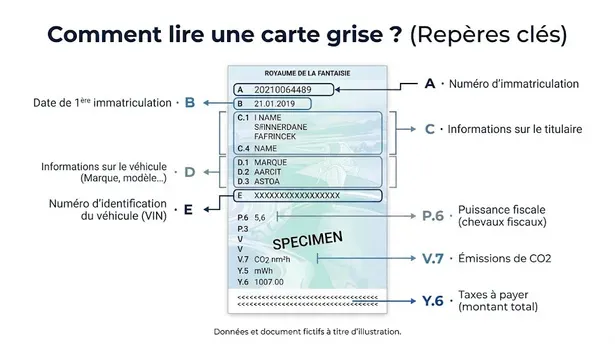
Reference A: the registration number
Field A shows the registration number, the one found on the front and rear plates. In SIV format, it is written as two letters, three numbers and two letters (AA-123-AA). Before buying, check that the number on the carte grise matches exactly the one on the vehicle's plates.
Field A.1, just below, is the national vehicle identifier, an internal SIV reference rarely useful in everyday life.
Reference B: the date of first registration
Field B gives the date the vehicle was first put on the road, that is, the date of its very first registration. This date is used to calculate the age of the vehicle, to determine the MOT requirement and to place the model within its generation. It should be consistent with the year stated in a classified ad.
Reference C: holder, co-holder and owner
Field C groups together information about the person or people linked to the certificate. C.1 shows the main holder's name and first name, C.3 their address, and C.4a specifies whether the holder is also the owner of the vehicle.
This distinction matters when buying a used car: check that the name in box C.1 is indeed that of the seller. A change of address must have been notified, otherwise there is a risk of a fine.
References D and E: vehicle identification and VIN number
Field D identifies the vehicle: D.1 for the make, D.2 for the type, variant and version (the CNIT, national type identification code), and D.3 for the commercial designation. D.2 allows you to find the exact version of the car, useful information for ordering a truly compatible spare part or knowing the value of the model.
Field E contains the VIN number, the 17-character vehicle identification number stamped at the factory. It is the same code as the one engraved on the chassis. You can decode the VIN to confirm the make, model and year, and consult our guide on the VIN code on the carte grise. Before buying, make sure that the VIN in field E is identical to that on the vehicle.
References F and G: the vehicle's masses
Fields F.1, F.2 and F.3 indicate the maximum authorised masses, in kilograms, set by the manufacturer. F.1 corresponds to the maximum authorised laden mass of the vehicle alone, F.2 to that authorised in the Member State of registration, F.3 to the total rolling weight, including trailer. Exceeding these values is dangerous for braking and road holding.
Field G gives the unladen mass of the vehicle, including bodywork and towing device for a towing vehicle. The total weight and payload can be deduced from these indications.
References H, I, J and K: validity, date, category and approval
Field H is the period of validity of the certificate: it remains blank when validity is unlimited, which is usually the case. Field I is the date of issue of the current title. Field J specifies the European category and the national type of the vehicle: J.1 for the category (passenger car, van), J.2 for the national type (VP, CTTE, agricultural), J.3 for the bodywork. Field K, the type approval number, is mainly filled in for imported vehicles or those that have undergone approval.
The national type indicates the use: a passenger car (VP), a van (CTTE) or an agricultural vehicle are subject to different MOT and tax rules.
Fiscal power, taxes and the price of the carte grise
Fiscal power and taxes are found in boxes P and Y of the carte grise. Fiscal power, expressed in fiscal horsepower, is the basis for calculating the price of the registration certificate. It appears in box P.6.
Reading the power (reference P) and fiscal horsepower (P.6)
Field P details the engine: P.1 the engine size in cubic centimetres, P.2 the maximum net power in kilowatts, P.3 the type of fuel or energy, and P.6 the national administrative power, the well-known fiscal horsepower. The actual power (P.2) gives information about performance; the fiscal power (P.6) is used to calculate taxes.
Field P.3 indicates the type of fuel or energy: petrol, diesel, electric, hybrid or LPG. For an electric vehicle, the fiscal power is often reduced, or even exempt from regional tax depending on the region.
Field Q gives the power-to-weight ratio, which only concerns motorcycles. CO2 emissions and environmental class are found in boxes V.7 and V.9, and have affected certain taxes for vehicles registered from June 2014 onwards.
How the price of the carte grise is calculated
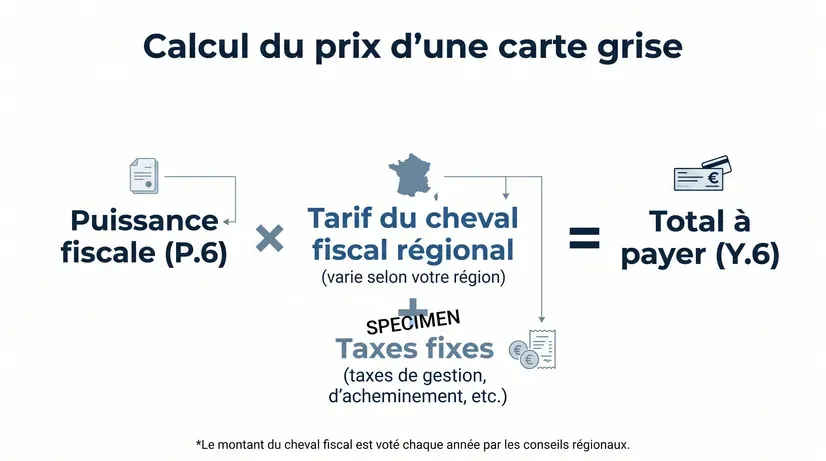
The price of the carte grise, also called the regional tax, is calculated from the fiscal power in box P.6. It adds together several components, detailed in the following table:
| Component | Calculation basis |
|---|---|
| Regional tax (Y.1) | Fiscal horsepower (CV) multiplied by the price of the fiscal horsepower set by the region |
| Fixed tax (Y.4) | National flat-rate amount |
| Delivery fee (Y.5) | Flat-rate for sending the document |
| Possible ecological malus | According to CO2 emissions (reference V.7), for vehicles concerned |
| Total (Y.6) | Sum of the taxes paid when issued |
The price of the fiscal horsepower varies from one region to another and can be revised each year. For an up-to-date estimate, see our article on the price of the carte grise. The details of the taxes actually paid are shown at references Y.1 to Y.6.
References S, U and Z: seats, noise level and specific mentions
The S field indicates the number of seated places (S.1) and standing places (S.2), including the driver's seat. The U field gives the stationary noise level (U.1) and the engine speed, that is, its rotational speed at the time of measurement (U.2). The Z section groups together specific mentions: for example, collector vehicle, driving school vehicle or adaptation for a disabled person.
Formula number, detachable coupon and provisional certificate
The formula number, the detachable coupon and the provisional certificate are three elements of the carte grise that do not have a letter reference, but play a key role during a sale or an online procedure.
Where to find the formula number and what it is used for
The formula number is a unique 11-character reference assigned to each registration certificate. It appears on the document, near the date at reference I, and on the back near the detachable coupon. It is essential for any online procedure on the ANTS website: declaration of transfer, request for a duplicate in case of loss, or new carte grise application after a purchase. To apply for a carte grise online, an authorised professional or a company mandated via a cerfa mandate can also use it on your behalf, with proof of address and an identity document. Our guide details the formula number and its exact location.
The detachable coupon and the crossed-out carte grise during a sale
The detachable coupon, located at the bottom right of the carte grise, allows the buyer to drive for one month while waiting for their own document. During a sale, the seller crosses out the carte grise, writes the date and time of the transfer, then signs it. Our article provides an explanation on how to cross out the carte grise without error.
Reading a provisional registration certificate (CPI)
The provisional registration certificate (CPI) is issued when applying online, while waiting to receive the final document. It authorises driving for one month in France. The CPI includes the essential information: registration number, holder's identity, technical characteristics and taxes paid. An authorised professional can issue it immediately in paper version.
Reading a European carte grise or a special case
A European carte grise is read using the same references as in France, as the coding from A to Z is harmonised by Directive 1999/37/EC. The VIN number, the date of first registration or the power can therefore be found at the same letters from one EU country to another.
The harmonised references in Europe
Thanks to this harmonisation, a buyer can decipher a German, Belgian or Italian carte grise by identifying the same letters. Only the language and layout change. For an imported vehicle, reference K (type approval number) and the European certificate of conformity allow you to check the correspondence with the model.
Two-wheelers, collector vehicles and imported vehicles
Certain vehicles follow their own rules. Motorcycles use reference Q for the power-to-weight ratio. Vehicles over thirty years old can obtain a collector carte grise, for which our guide details how to obtain it. Imported vehicles often require a tax clearance certificate and individual approval before registration.
Checking the consistency of the carte grise before buying
Before buying a used car, checking that the fields on the carte grise match the actual vehicle and the advert avoids most unpleasant surprises. Four references are a priority.
First, check that the registration number (A) matches the plates, that the VIN (E) is identical to that stamped on the chassis, that the make and version (D) correspond to the model, and that the date of first registration (B) matches the stated age. Any inconsistency in one of these boxes should be a warning sign.
The carte grise describes the vehicle as it was registered, not its history. A history report completes this reading, depending on the data available: declared accidents, mileage records, administrative status. Before signing, you can check the consistency of the vehicle using its plate or VIN.
Also remember to compare the fields on the carte grise with the advert and, at the time of sale, to check the certificate of transfer and the absence of any encumbrance. These checks are just as important for those wishing to buy as for those about to sell a used car.
The carte grise is also used on a daily basis: it determines the insurance quote, whose rate depends on the fiscal horsepower, and it specifies whether the vehicle is subject to long-term leasing. For a vehicle still under warranty, field D.2 helps confirm the covered version. A spare part is also ordered using this information.
Reading your carte grise, then checking the vehicle
Reading a carte grise means decoding its fields from A to Z: the registration number (A), the date of first registration (B), the holder (C), identification and VIN (D and E), fiscal horsepower (P.6) and taxes (Y). The formula number, for its part, enables online procedures.
These fields describe the vehicle on paper. To know its history before a purchase, the history report takes over. You can check a vehicle
With Autorigin, access the essential information to better understand a car's past.
Get a history report