
Check its history before you commit.
The fiscal horsepower (chevaux fiscaux) of a car appears in box P.6 of the carte grise (French vehicle registration certificate), under the heading of national administrative power. This number of CV, multiplied by the fiscal horsepower rate set by each region, gives the amount of the regional tax, which is the first line in the price of a carte grise. It does not measure the actual engine power, which is shown in kilowatts in box P.2. For a second-hand buyer, these two figures are used to budget for registration and to check that the vehicle matches the advert. Here is how to read box P.6, how fiscal power is calculated, and how much a fiscal horsepower costs in your region in 2026.
Where to find the fiscal horsepower on the carte grise?
The fiscal horsepower is listed in box P.6 of the registration certificate. This is where you should look when wondering where to find the fiscal power: the figure is given in fiscal horsepower, noted as CV, and it is used as the basis for calculating the price of the carte grise.
Box P.6: the national administrative power
The administrative power is the fiscal power of a vehicle, established by the authorities based on its technical characteristics. Section P.6 is labelled 'national administrative power', according to the decree of 22 September 2003 relating to vehicle registration.
The Code des impositions sur les biens et services specifies that the value entered on the registration certificate is deemed to be correct (article L421-22). The figure in section P.6 is therefore the one used by the authorities, with no need for you to recalculate it. You do not need to calculate the fiscal power yourself.
P.1, P.2, P.3: neighbouring boxes not to be confused
On the carte grise, each section is identified by a letter. The letter P groups together information about the engine: each marker combines this letter with a number and refers to a specific piece of data. This letter system is the same on all current-format cartes grises.
| Box | Data indicated | Unit | What it is used for |
|---|---|---|---|
| P.1 | Engine capacity | cm³ | Engine size |
| P.2 | Maximum net power | kW | Actual engine power |
| P.3 | Type of fuel or energy source | Code | Petrol, diesel, electric, etc. |
| P.6 | National administrative power | CV | Calculation of the regional tax |
Source: decree of 22 September 2003 amending the decree of 5 November 1984 relating to vehicle registration.
The other sections, such as the VIN number in section E or the date of first registration in section B, are detailed in our guide to reading a carte grise section by section.
Finding the fiscal power without the carte grise
During a sale, the seller must provide certain documents to the buyer, according to Service Public. Before travelling, ask for a photo of the certificate: section P.6 gives you the number of CV in a few seconds.
Without this document, the registration plate remains a good starting point. Our article on how to find out your car's power using the registration plate details this method.
Fiscal horsepower, DIN horsepower, kilowatts: what is the difference?
The fiscal horsepower is an administrative unit used to calculate the carte grise. DIN horsepower and kilowatts, on the other hand, measure the actual power delivered by the engine.
Fiscal horsepower, a taxation unit
Fiscal horsepower is not a physical measurement. It is a whole number, called 'cheval administratif' by the Code des impositions sur les biens et services, rounded to the nearest whole number (article L421-14).
The number of fiscal horsepower is used as the basis for the regional tax on the carte grise. This is not an annual circulation tax: this amount is paid each time a new carte grise is issued, for example after a purchase. The number of CV is also used as a reference for the mileage scale provided for in article 83 of the Code général des impôts for travel expenses in a private car.
DIN horsepower and kilowatts: the actual engine power
The kilowatt is the legal unit of power. Section P.2 indicates the maximum net power of the engine in kilowatts: this is the actual power figure shown on the carte grise.
DIN horsepower, also called metric horsepower and noted as ch, is the unit used in technical specifications and adverts. The conversion is simple: 1 kW corresponds to about 1.36 ch. For example, an Autorigin report shows 101 ch for a 74 kW engine. This conversion never gives the number of fiscal horsepower, which is calculated using a different formula.
Why two cars with the same power do not necessarily have the same fiscal horsepower
The calculation method varies according to the date of first registration in France. For a car registered before 2021, the fiscal power results from the standards in force at the time, which included CO2 emissions (article L421-15).
Since 1 January 2021, it depends solely on the maximum net power (article L421-16). Two cars with 100 kW engines can therefore show a different number of CV if one dates from 2018 and the other from 2022. The only figure that counts is the one in section P.6.
How is fiscal power calculated?
To calculate fiscal power, the authorities apply a formula set by law, which varies according to the type of vehicle and its date of first registration. For a car registered in France since 2021, the calculation of power depends solely on the engine power in kilowatts.
The formula for cars registered since 2021
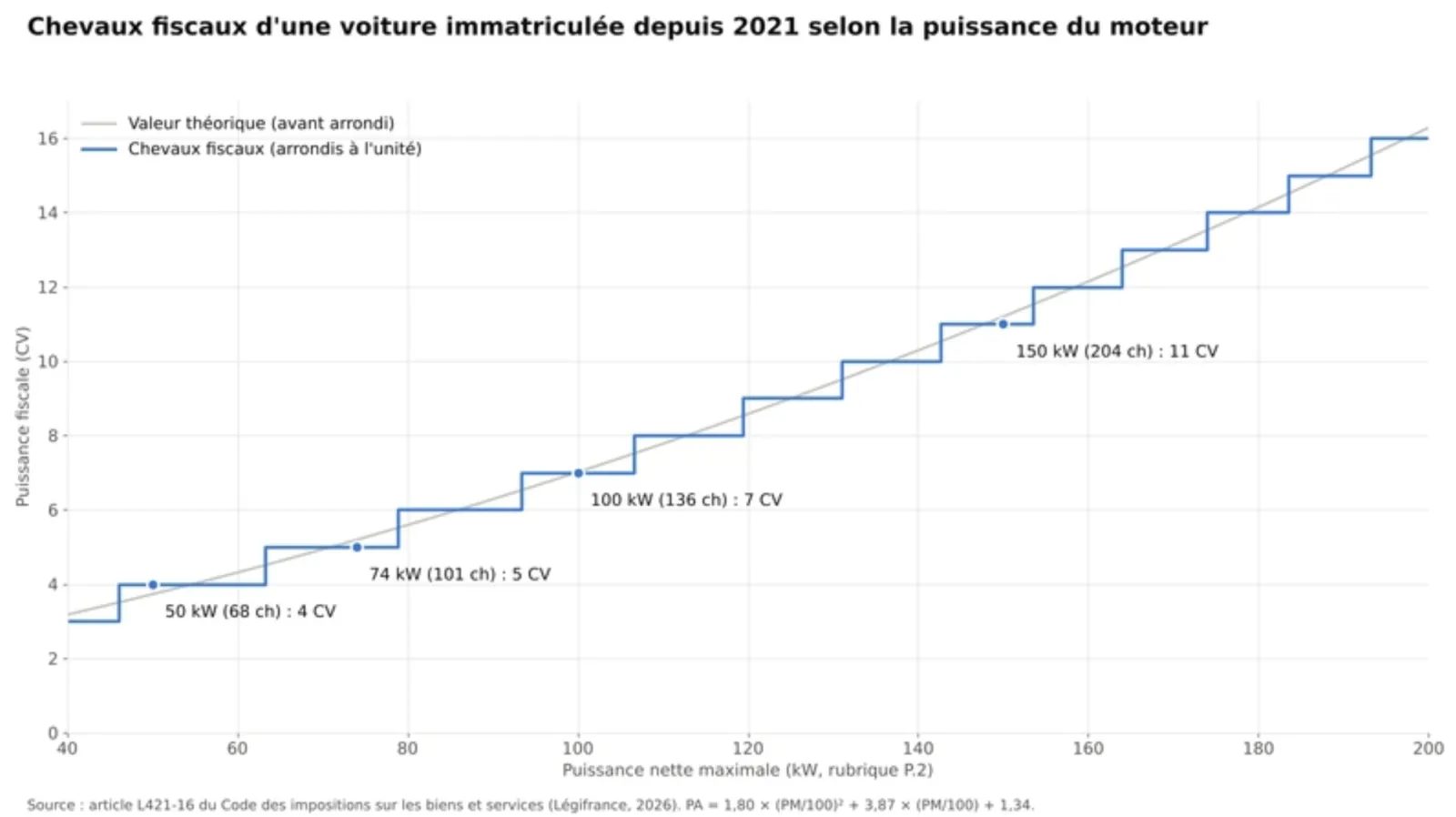
For a passenger car registered for the first time in France since 1 January 2021, article L421-16 of the Code des impositions sur les biens et services sets out the following formula, with PM being the maximum net power in kW:
PA = 1.80 × (PM/100)² + 3.87 × (PM/100) + 1.34
The theoretical result is rounded to the nearest whole number. Example calculation for a 100 kW engine: 1.80 + 3.87 + 1.34 = 7.01, i.e. 7 CV. For a 74 kW engine, the result is 5.19, i.e. 5 CV.
Source: article L421-16 of the Code des impositions sur les biens et services (Légifrance, 2026)
Older vehicles
For a vehicle first registered in France up to 31 December 2020, the administrative power is that provided for by the standards of the time (article L421-15). For passenger cars first put into circulation from 1 July 1998, law no. 98-546 of 2 July 1998 set the formula PA = CO2/45 + (P/40)^1.6, with P being the actual engine power in kW and CO2 the emissions in g/km.
These vehicles retain the fiscal power shown on their carte grise. A change of owner does not alter it.
Electric and hybrid cars
An electric or hybrid passenger car registered since 2021 follows the same formula as other passenger cars (article L421-16). For other electric vehicles, article L421-20 provides PA = 1 + 0.067 × PM for approval from 1 March 2026, compared with 1 + 0.136 × PM previously.
In terms of price, the region may halve or cancel the fiscal horsepower rate for a vehicle running exclusively on electricity or hydrogen (article L421-49).
The case of motorbikes
For a motorbike with a combustion engine, the administrative power depends on the engine capacity in litres, according to a scale defined in article L421-17, rounded up to the next whole number. The regional rate is halved for motorbikes in categories L3e and L4e and zero for mopeds in categories L1e and L2e (article L421-46).
What is the price of fiscal horsepower in 2026 by region?
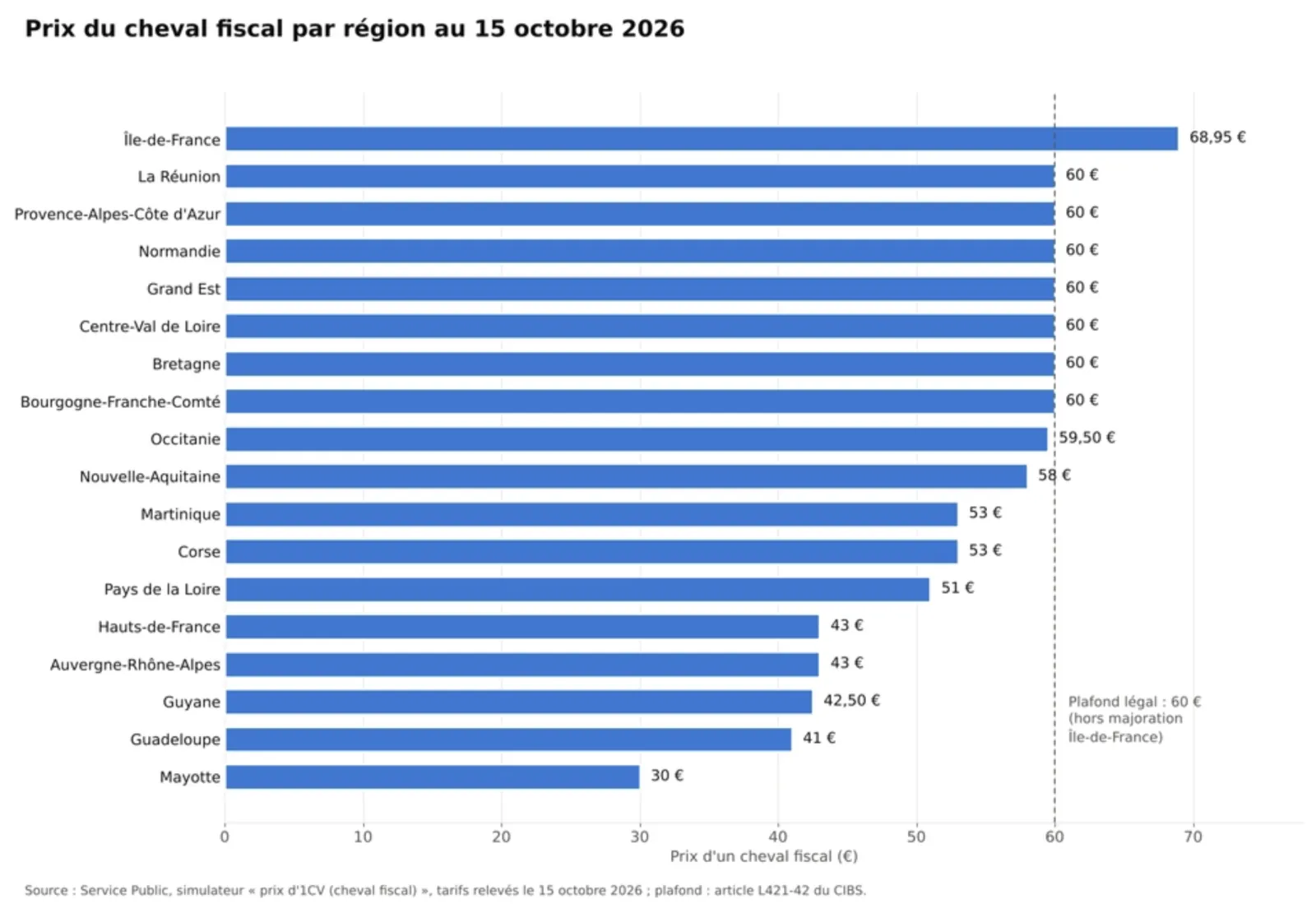
On 15 October 2026, the price of fiscal horsepower ranges from €30 in Mayotte to €68.95 in Île-de-France, according to the Service Public simulator. Six regions in mainland France apply €60, the ceiling set by article L421-42, excluding the Île-de-France surcharge: Brittany, Normandy, Grand Est, Bourgogne-Franche-Comté, Centre-Val de Loire and Provence-Alpes-Côte d'Azur. Nouvelle-Aquitaine applies €58, Corsica €53.
Table of regional rates 2026
The table below shows the rate of one fiscal horsepower in each region and the amount of the regional tax for a car with 6 CV less than 10 years old:
| Region | Price of one fiscal horsepower | Regional tax for 6 CV |
|---|---|---|
| Île-de-France | €68.95 | €413.70 |
| Auvergne-Rhône-Alpes | €43 | €258 |
| Bourgogne-Franche-Comté | €60 | €360 |
| Brittany | €60 | €360 |
| Centre-Val de Loire | €60 | €360 |
| Corsica | €53 | €318 |
| Grand Est | €60 | €360 |
| Hauts-de-France | €43 | €258 |
| Normandy | €60 | €360 |
| Nouvelle-Aquitaine | €58 | €348 |
| Occitanie | €59.50 | €357 |
| Pays de la Loire | €51 | €306 |
| Provence-Alpes-Côte d'Azur | €60 | €360 |
| Guadeloupe | €41 | €246 |
| Martinique | €53 | €318 |
| Guyane | €42.50 | €255 |
| La Réunion | €60 | €360 |
| Mayotte | €30 | €180 |
Source: Service Public, simulator 'Carte grise: what is the price of 1CV (fiscal horsepower)?', rates as of 15 October 2026. The Île-de-France rate includes the surcharge provided for in article L421-54-1 since 1 March 2026.
Each region sets its own rate and may change it during the year. In Hauts-de-France, for example, the price of fiscal horsepower rose from €42 to €43 on 1 April 2026, according to Service Public. Check the current rate on the official service-public.gouv.fr tool before starting your procedure: the price of fiscal horsepower by department is shown there based on your place of residence.
Source: Service Public, fiscal horsepower price simulator, rates as of 15 October 2026
Exemptions and reductions by region
Several national and regional rules can reduce the cost:
- Vehicle aged 10 years or more: the regional rate is halved when the first registration dates back ten years or more (article L421-45).
- Electric or hydrogen vehicle: half-rate or exemption by regional decision (article L421-49). In Hauts-de-France, the reduction changed from 100% to 50% on 1 April 2026.
- Two-wheelers: half-rate for L3e and L4e motorbikes, zero rate for L1e and L2e mopeds (article L421-46).
How is the price of a carte grise calculated?
The price of a carte grise is the sum of four taxes and a fee, according to Service Public. The impact of fiscal horsepower (chevaux fiscaux, CV) is direct: each additional CV affects the price, according to your region's rate. For a used car already registered in France, most of the amount comes from the regional tax, which equals the number of fiscal horsepower multiplied by the regional rate.
The items that make up the price of a carte grise
- Regional tax: number of CV multiplied by the regional rate, up to a maximum of €60 per CV excluding the Île-de-France surcharge (article L421-42).
- Tax on transport vehicles, depending on the vehicle category (Service Public).
- Tax on CO2 emissions for passenger vehicles, known as the malus: this is zero for a vehicle whose first registration was before 1 January 2015 (article L421-60).
- Fixed tax: €11 (article L421-38). This is not due for a simple change of address (article L421-39).
- Certificate delivery fee: €2.76.
If you use an authorised professional, they will also charge an administration fee for their service. The amount is freely set by the professional, as Service Public reminds.
Example calculation for a used car
Let's take a car with 6 CV, first registered in France in 2022, bought by a private individual living in Brittany, where the fiscal horsepower costs €60:
- Regional part: 6 × €60 = €360.
- Fixed part: €11.
- Delivery fee: €2.76.
- Total: €373.76, excluding malus, which is not due in this example, and excluding any administration fees.
The same car would cost €319.76 in Pays de la Loire, at €51 per CV. If it were over 10 years old, the regional part in Brittany would drop to €180, for a total of €193.76. For your own vehicle, the Service Public simulator gives the exact amount.
After buying a used car: timeframe and procedures
After buying a used vehicle, you have one month to apply for the new registration certificate (carte grise), according to Service Public. The application is made online on the ANTS website or through an authorised automotive professional. The same rule applies to a vehicle bought abroad, with additional documents required.
The seller, for their part, declares the transfer of the vehicle to the authorities and gives you the sales documents. You become the new holder of the carte grise. Keep the certificate of transfer: it proves the date of the transaction.
Vehicle on lease (LLD, LOA): who pays for the carte grise?
For leasing, whether LLD or LOA, the regional tax is due by the person who holds the vehicle according to the law. When it is a rental company, the rate applied is that of the region of the establishment to which the vehicle is assigned (article L421-43).
For a lease of less than two years, it is the region of the establishment where the vehicle is made available under the first contract that counts. Before signing a leasing contract, check whether the cost of the carte grise is included in the payments.
Buying a used car: what fiscal horsepower tells you
For a used car buyer, fiscal horsepower is first used to calculate the carte grise before signing. Compared with the advert and the vehicle, the carte grise can also help spot any inconsistency before payment.
Including the carte grise and insurance in your purchase budget
For a car with 6 CV less than 10 years old, the regional part ranges from €180 in Mayotte to €413.70 in Île-de-France, according to Service Public rates as of 15 October 2026. Calculate this amount during negotiations: it is added to the sale price.
Also request a car insurance quote using the carte grise of the vehicle in question. The quote is based on the vehicle's precise characteristics, not just the advert description.
Checking consistency between the advert, the carte grise and the vehicle
- Compare the power stated in ch with section P.2 of the carte grise, converted into kW.
- Note the number of CV in section P.6 to calculate the cost of the future carte grise.
- Check that the VIN number in section E matches the one engraved on the vehicle.
- If in doubt about the version, identify the original engine with the VIN decoder.
“In an advert, the power is often given in DIN horsepower. Compare it with section P.2 of the carte grise, converted into kilowatts: a clear difference justifies a question to the seller before any payment,” explains Pierre-Emmanuel Tanguy, Managing Director of Autorigin.
What the history report adds before you pay
The carte grise describes the vehicle as it is currently registered. The Autorigin history report traces its past from the number plate or VIN in a few seconds.
- Declared accidents and recorded claims.
- Mileage checks, with detection of suspicious decreases.
- Previous uses, such as taxi or rental.
- Legal status: pledge, opposition, theft report.
- Estimated value based on similar adverts.
The Autorigin report example also shows, in the vehicle overview, the fiscal horsepower and DIN horsepower. The report only contains officially recorded information: an undeclared incident may not appear. According to Autorigin, over 30 million reports were consulted in 2025.
Key points to remember
- Fiscal horsepower is shown in section P.6; the actual engine power is in kW in section P.2.
- Regional tax = number of CV × regional rate, from €30 to €68.95 per CV as of 15 October 2026.
- Since 2021, the fiscal horsepower of a car depends solely on its maximum net power.
With Autorigin, access the essential information to better understand a car's past.
Get a history report