
Check its history before you commit.
The VIN number (Vehicle Identification Number) is the unique 17-character code that identifies a car among all others. It can be found at reference E on the carte grise and in several places on the vehicle. This VIN code remains the same from the factory to destruction, even if the registration plate or owner changes. It is governed by the ISO 3779 standard. Reading the VIN number correctly allows you to decode the car's factory characteristics, order the right parts, and obtain a reliable history report before buying a used car. Here is where to find the VIN number on the carte grise and the vehicle, how to read its 17 characters, how to decode it by brand, and what to do if it does not match.
What is the VIN number (Vehicle Identification Number)?
The VIN number is the unique and permanent identifier of a vehicle, made up of 17 alphanumeric characters. Assigned by the manufacturer at production, it is never reused for another vehicle. It is the equivalent of an identity card engraved for life in the car.
This code is governed by the international ISO 3779 standard, which sets its length, structure, and the characters allowed. Since 1981, manufacturers selling in Europe and North America have used this unique 17-character format. Older vehicles had shorter, non-standardised serial numbers.
What is the VIN number used for?
The vehicle identification number is used to identify a vehicle with certainty, regardless of its country or owner. Its main uses are as follows:
- ordering spare parts that are exactly compatible with the model and its engine;
- checking the vehicle's history, especially before buying a used car;
- checking manufacturer recalls published for the model;
- identifying a stolen or damaged vehicle with the authorities.
For spare parts, the VIN number gives the exact reference for the model and its engine: the seller can find the correct part with no risk of error. For a sale, the buyer uses it to run a vehicle check and confirm that the car matches the advert.
A VIN decoder reads this code and extracts the factory characteristics: make, model, body type, engine, year, and manufacturer's country code. A history report links the number to the vehicle's past, according to the data available.
VIN, serial number and chassis number: are they the same?
The VIN number is also called the chassis number or serial number, as it is often stamped on the chassis. These three terms refer to the same 17-character code. The VIN should not be confused with the engine number, which is specific to the engine block, nor with the registration plate, which can change during the vehicle's life.
Where to find the VIN number on the car and the carte grise?
The VIN number appears at reference E on the carte grise and in several physical locations on the vehicle. This redundancy allows it to be found and its consistency checked, even if a plate is erased. Here are the most common locations:
| Location | Exactly where | Note |
|---|---|---|
| Carte grise (registration certificate) | Reference E | Official location of the identification number |
| Bottom of windscreen | Driver's side, visible from outside | Small plate readable through the glass |
| Driver's door pillar | Label at the B-pillar | Often with tyre pressures and weight |
| Engine compartment | Manufacturer's plate near the bonnet | Stamped metal or riveted label |
| Chassis | Under the vehicle or under the front seat | Number stamped into the metal |
| Documents | Certificate of conformity, service book | Useful if the vehicle is not accessible |
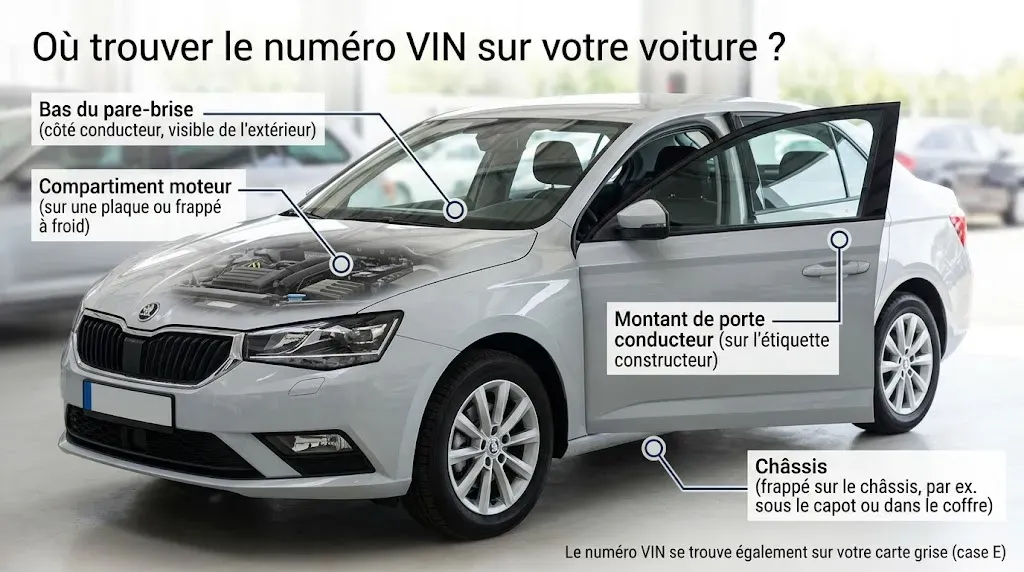
Source: ISO 3779 standard.
The VIN number on the carte grise (reference E)
On the French registration certificate, the VIN number is shown at reference E, below the registration information. This is the official reference to compare with the code stamped on the vehicle. For an old certificate, the layout is different: the guide to finding the VIN on an old carte grise details special cases, and the article dedicated to the VIN code on the carte grise explains each section.
The locations of the VIN number on the vehicle
On the car, the first thing to check is the bottom of the windscreen on the driver's side, at the dashboard, then the label on the driver's door. The manufacturer's plate in the engine compartment also bears the number. On recent models, the VIN sometimes appears in the onboard computer, under diagnostics or identification.
Before buying, checking the number in at least two places helps to detect any inconsistency. Take a clear photo of the VIN: it will be useful to decode the code and to run a history report at your leisure.
How to read and decode the 17 characters of the VIN number?
The 17 characters of the VIN number are read in three sections defined by the ISO 3779 standard: the WMI (manufacturer code), the VDS (descriptor code), and the VIS (indicator code). Each section provides specific information about the vehicle's origin and characteristics.
| Section | Characters | Information |
|---|---|---|
| WMI (World Manufacturer Identifier) | 1 to 3 | Geographical area and manufacturer |
| VDS (Vehicle Descriptor Section) | 4 to 9 | Characteristics: model, body, engine; the 9th is a check digit |
| VIS (Vehicle Identifier Section) | 10 to 17 | 10th character: model year; 11th: plant; last 6: serial number |
The letters I, O and Q are excluded from the VIN to avoid confusion with the numbers 1 and 0. A code containing any of these characters is therefore necessarily incorrect.
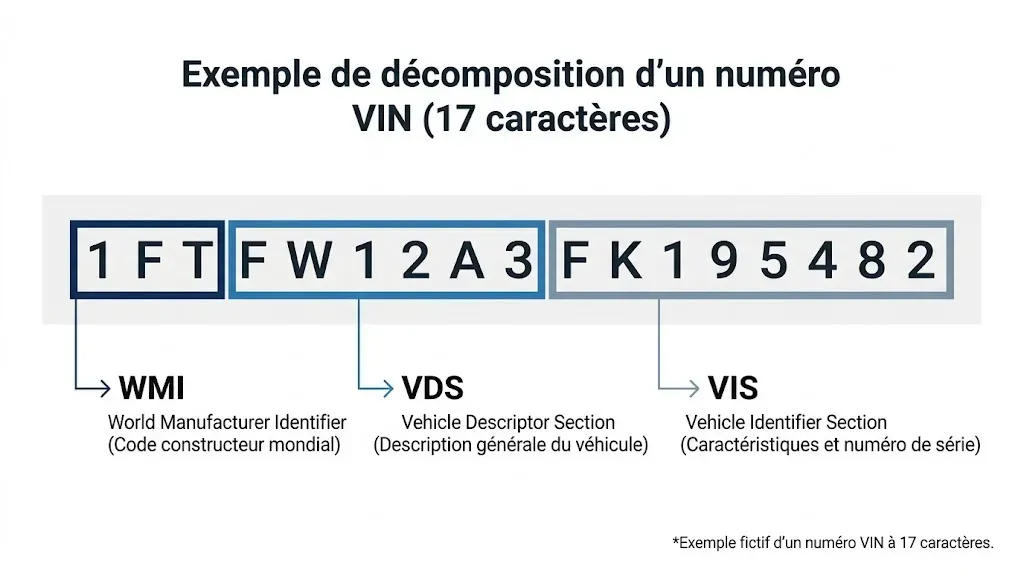
Source: ISO 3779 standard.
The WMI: country of origin and manufacturer
The WMI (World Manufacturer Identifier) occupies the first 3 characters and indicates the geographical area and then the manufacturer. This manufacturer code allows the VIN to be decoded by country. The first character designates the manufacturing region, according to the following breakdown:
| First character | Geographical area | Example countries |
|---|---|---|
| 1 to 5 | North America | United States, Canada, Mexico |
| 6 to 7 | Oceania | Australia, New Zealand |
| 8 to 9 | South America | Brazil, Argentina |
| A to H | Africa | South Africa |
| J to R | Asia | Japan, Korea, India |
| S to Z | Europe | France (V), Germany (W), Italy (Z), Spain (V) |
The country code is read from the first character. For example, a VIN starting with V often indicates a manufacturer from France or Spain, with W a manufacturer from Germany, with Z a manufacturer from Italy, with J a manufacturer from Japan. The second and third characters specify the manufacturer, for example the type of vehicle produced.
For more detail by brand, Autorigin offers a dedicated decoder that applies the conventions specific to each manufacturer, for example for Peugeot, Renault, Volkswagen or BMW.
The VDS and VIS: characteristics, model year and serial number
The VDS (descriptor section) covers characters 4 to 9 and describes the vehicle: model line, body type, engine, and sometimes the vehicle's safety equipment. The 9th character is a check digit, mainly used in North America to validate the code.
The VIS (identifier section) covers characters 10 to 17. The 10th character indicates the model year, the 11th identifies the assembly plant, and the last six form the car's serial number in that plant.
The model year code follows a convention that repeats in 30-year cycles. For example, the letter A corresponds to 1980 then to 2010, the letter L to 1990 then to 2020, the number 5 to 2005 then to 2035. The letters I, O, Q, U, Z and the number 0 are never used for the year. The vehicle's context clarifies any ambiguity from one generation to another. This character changes with each model generation.
How to decode and check a VIN number for free?
To decode a VIN number, an online decoder reads the 17 characters and displays the vehicle's factory characteristics. Checking the code is free. To find out the car's history, however, you need a history report, which is paid for: its price depends on the chosen offer. Decoder and report meet two different needs.
The VIN decoder and the brand-specific decoder
A VIN decoder is a free verification tool that breaks down the code and returns the manufacturer's specifications: make, model, engine, year. The Autorigin VIN decoder covers all brands, and brand-specific decoders refine the reading according to each manufacturer's conventions. The search can be done using the VIN number, or from the registration plate for a vehicle registered in France. The decoding shows what the car was when it left the factory, not what it has become since.
From the VIN number to the vehicle history report
The history report links the VIN number to the vehicle's past, according to the available data: reported accidents and damage, mileage records, changes of ownership, administrative status, vehicle reported stolen. This is a useful step before buying a used car. Automotive professionals have a dedicated process, described in the VIN verification guide for professionals.
No report guarantees an exhaustive history: it lists the events recorded and accessible via official sources. It complements the examination of documents, the technical inspection and the test drive. Before buying, you can obtain the history report using the VIN.
The VIN number does not match: what should you do?
When the vehicle's VIN number does not match the one on the carte grise, there are two possibilities: a simple entry error, or a sign of fraud. The response is not the same.
Entry error on the carte grise
An error on a character of the registration certificate is an administrative mistake. The holder requests a correction online on the ANTS website, as for an online carte grise application, with supporting documents, notably the vehicle's certificate of conformity. Correction of an error attributable to the administration is free of charge. Also remember to check the VIN entered on the transfer certificate at the time of purchase: it must be identical to that on the carte grise and the vehicle.
As long as the document is not corrected, a history report launched with the incorrect VIN would return information for another vehicle. An error of just one character is enough to distort the result.
Illegible, altered or suspicious VIN number
A VIN number that is filed down, overstruck, covered or whose characters are irregular is a major warning sign. It may indicate a stolen or disguised vehicle. In this case, it is best to abandon the purchase, check the vehicle's history and, in case of serious doubt, report it to the authorities. Modifying or falsifying a VIN number is an offence: this guide explains how to read and check it, never how to alter it.
From VIN number to history: check before you buy
The VIN number is the unique 17-character code that identifies a car for life. It can be found at reference E on the carte grise, decoded into three sections (WMI, VDS, VIS) and checked at several locations on the vehicle.
Before buying, this same number gives access to the vehicle's past: claims, mileage, administrative status. Decode your VIN or check a vehicle by its VIN before making a commitment.
With Autorigin, access the essential information to better understand a car's past.
Get a history report