
Check its history before you commit.
For a private car, the first vehicle inspection (contrôle technique) takes place within the 6 months preceding the 4th anniversary of its first registration, then every two years, according to Service Public. However, the frequency changes depending on the vehicle category: commercial vehicles, heavy goods vehicles, two-wheelers or licence-free cars each follow their own rules. Here is the frequency by vehicle type, how the inspection works, possible outcomes, penalties for non-compliance and what to check before buying a used car.
How often should you have a vehicle inspection?
The basic rule for a private car is simple: a first vehicle inspection at 4 years, then an inspection every two years. The vehicle inspection is designed to ensure that the vehicle remains safe and low-polluting throughout its life. This periodic technical inspection is a legal requirement in France, and failure to comply is subject to a penalty. The authorities have entrusted supervision to a network of approved centres.
The first inspection of a new vehicle (4 years)
A new vehicle does not require a vehicle inspection during its first years. The first inspection must take place within the 6 months preceding the date of the 4th anniversary of its first registration, indicated at reference B on the carte grise (French registration certificate). It is best to schedule it a little before this deadline to avoid any delay.
The frequency: every two years
Once the first inspection has been carried out, subsequent inspections take place every two years if the result is favourable. The deadline for the next inspection is shown on the report issued by the centre and on the sticker affixed to the windscreen. Meeting this deadline avoids fines and unpleasant surprises.
The vehicle inspection for a used car
For a used car, the frequency remains the same: every two years after the first inspection. The date of the next inspection depends on the last inspection carried out, as shown on the report. When buying, this document indicates when the next vehicle inspection is due and provides information on the value and condition of the vehicle. It is one of the documents to request from the seller.
Which vehicles are concerned, and how often?
The frequency of the vehicle inspection depends on the vehicle category. Private cars follow the two-year rule, but heavy goods vehicles, two-wheelers or licence-free cars follow different schedules. The table below summarises the frequency by category.
| Vehicle category | First inspection | Frequency |
|---|---|---|
| Private car (GVWR up to 3.5 t) | Before the 4th anniversary | Every 2 years |
| Light commercial vehicle and van (up to 3.5 t) | Before the 4th anniversary | Every 2 years, with an additional anti-pollution inspection |
| Camper van (up to 3.5 t) | Before the 4th anniversary | Every 2 years |
| Heavy goods vehicle (over 3.5 t) | Before the 1st anniversary | Every year |
| Two- and three-wheeled motor vehicles, quadricycles | According to the schedule in force since 2024 | Every 3 years (to be confirmed) |
| Licence-free car (light quadricycle) | According to the quadricycle schedule | According to the category |
| Classic vehicle (over 30 years old) | According to the carte grise de collection | Spaced out (to be confirmed) |
Private cars, vans and camper vans under 3.5 tonnes remain on the two-year schedule. Heavy goods vehicles, on the other hand, undergo an inspection every year due to their intensive use.
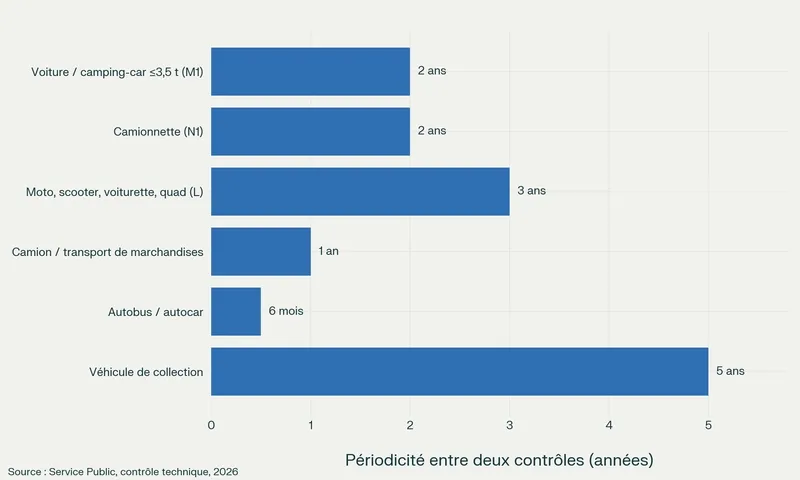
Source: Service Public, vehicle inspection, 2026
Two-wheeled motor vehicles and quadricycles: the new schedule
The vehicle inspection for two- and three-wheeled motor vehicles and motorised quadricycles, including licence-free cars, came into force in April 2024. Introduced gradually, the first inspection follows a staggered schedule depending on the date of first registration. This concerns motorbikes, scooters over 125 cc, three-wheelers and quadricycles, including microcars. The exact frequency and deadlines are still evolving: check the Service Public website before your inspection date.
Goods transport vehicles and those used by a business follow rules similar to those for commercial vehicles, with an additional anti-pollution inspection. If in doubt about the category, the type indicated on the carte grise (reference J) can be used to confirm it.
Commercial vehicle, camper van and classic vehicle
A van or light commercial vehicle follows the two-year rule, with an additional inspection of pollutant emissions in between. A camper van under 3.5 tonnes is subject to the same schedule as a car. A classic vehicle, registered as such, benefits from a more spaced-out frequency, to be confirmed according to its carte grise.
Where to have the vehicle inspection and at what price?
The vehicle inspection is carried out at a centre approved by the State. The price is not set by law: each centre determines it freely, depending on the service, vehicle type, engine and department. No maximum price is imposed, and prices vary from one region to another. Comparing nearby centres is a simple way to save money before making an appointment. Payment is made at the centre, at the end of the service.
A professional who makes a vehicle available or uses it for the transport of goods must ensure that it remains compliant and up to date with its inspection. The responsibility for the process lies with the vehicle holder, whether an individual or a business.
How does the vehicle inspection work and what are the possible outcomes?
The vehicle inspection is carried out at an approved centre, without dismantling, and covers a large number of inspection points. At the end, the inspector gives one of three possible results, which determine validity and whether a follow-up inspection is required.
| Result | Meaning | Consequence |
|---|---|---|
| Favourable | No major or critical defect | Valid for 2 years (private car) |
| Unfavourable, major defect | Fault to be repaired | Follow-up inspection to be carried out within 2 months |
| Unfavourable, critical defect | Fault compromising safety | Driving permitted until the end of the day, then follow-up inspection within 2 months |
In the event of a follow-up inspection, only the defective points are rechecked, within the two-month period. After this, a full vehicle inspection must be carried out again. The report details each defect found.
An anti-pollution section measures exhaust emissions and correct engine adjustment, which is also useful for fuel consumption. An abnormal emission rate is a defect to be corrected. This periodic technical inspection is aimed at both road safety and limiting pollution.
Inspection points and the follow-up inspection
The inspector checks, in particular, the braking, steering, road holding, lighting, visibility, structure, equipment and emissions. Defects found during the inspection are classified as minor, major or critical. Only major and critical defects require a follow-up inspection. A vehicle inspection carried out in accordance with the rules is the responsibility of the approved centre.
Having a vehicle inspection without a carte grise
The registration certificate is usually requested at the centre. In case of loss, theft or retention of the document, solutions exist, detailed in our article on having a vehicle inspection without a carte grise.
How to prepare your vehicle for the inspection?
A few simple checks before the appointment reduce the risk of a follow-up inspection. Here are the main points to check yourself:
- the number plate: compliance, legibility and match with the registration certificate;
- tyres: wear, pressure and absence of bulges or tears;
- brakes: condition of pads and discs, brake fluid level;
- shock absorbers: no oil leaks, corrosion or deformation;
- exhaust: no abnormal smoke and no corrosion of the exhaust system;
- lighting and visibility: lights, indicators, windscreen, wipers and mirrors;
- structure and bodywork: no perforating corrosion or major impact;
- interior equipment: seat fastening and good condition of seat belts.
Regular maintenance and early repair of visible faults are better than a follow-up inspection, which costs time and sometimes a second appointment.
What are the penalties for failing to have a vehicle inspection?
Driving with an expired or missing vehicle inspection is an offence under the Highway Code. In the event of a roadside check, the owner risks a fixed fine, immobilisation of the vehicle and retention of the registration certificate, according to Service Public.
Fine, immobilisation and retention of the certificate
The fixed fine is 135 euros (4th class offence), amount to be confirmed on Service Public. The police may immobilise the vehicle and retain the registration certificate, issuing a temporary circulation slip for a few days to regularise the situation. No reminder letter is sent by the authorities: it is the holder's responsibility to comply with the deadline. Driving without a valid vehicle inspection can also complicate compensation by car insurance after an accident, as the insurer may invoke non-compliance. Details of the penalties for failing to have a vehicle inspection are covered in our dedicated guide.
How long can you drive without a vehicle inspection?
There is no legal tolerance: as soon as the inspection has expired, the vehicle is no longer compliant. For special cases and deadlines, see our article on how long you can drive without a vehicle inspection.
Vehicle inspection and buying a used car: what to check
To sell a car over 4 years old to a private individual, the seller must provide a vehicle inspection (contrôle technique) less than 6 months old, according to Service Public. This document is therefore a key item to check before purchase, as it provides information on the vehicle's actual condition.
The vehicle inspection less than 6 months old required for sale
The inspection report less than 6 months old, or less than 2 months old if a follow-up inspection (contre-visite) has been prescribed, must be given to the buyer. Reading the recorded defects, even if repaired, gives a precise idea of the vehicle's condition. Our article on vehicle inspection and maintenance of a used car details what to look for.
The vehicle inspection provides a snapshot of the vehicle at a given moment, not its entire history. A history report complements this reading, depending on available data: accidents, mileage, and administrative status. Before signing, you can check the history and the latest vehicle inspection using the number plate or VIN.
Before buying, check the vehicle inspection and history
The rule can be summed up in one sentence: first vehicle inspection before 4 years, then every two years for a private car, with specific schedules for other categories. For a sale, an inspection less than 6 months old is mandatory.
This document remains a snapshot. Before committing to a used car, you can check a vehicle before buying, its latest vehicle inspection and its history, using its number plate.
Sources
- Service Public, vehicle inspection of a car (frequency, first inspection, results): https://www.service-public.gouv.fr/particuliers/vosdroits/N31200
- Service Public, selling a used vehicle (vehicle inspection less than 6 months old): https://www.service-public.gouv.fr/particuliers/vosdroits/F1707
- Ministère de la Transition écologique, vehicle inspection (two-wheelers, schedule): https://www.ecologie.gouv.fr/politiques-publiques/controle-technique-vehicules
With Autorigin, access the essential information to better understand a car's past.
Get a history report