
Check its history before you commit.
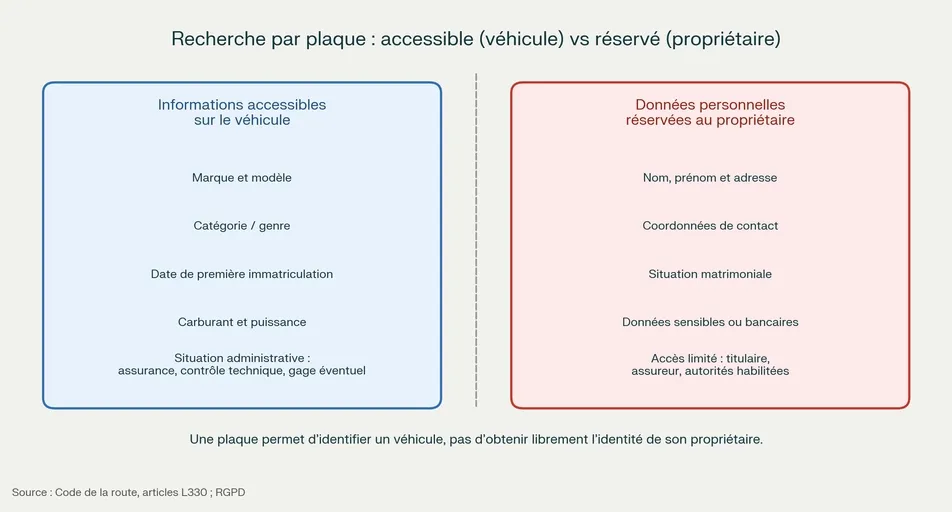
A number plate lookup allows you to obtain information about a vehicle, such as its model, features, and history, but not the identity of its owner. Access to the holder's contact details is reserved for authorised parties and regulated by the GDPR. For a used car buyer, the useful and legal number plate search concerns the vehicle's history. Here is what a number plate can provide, why you cannot find the owner yourself, and how to check a car's history before buying.
How to carry out a number plate lookup?
To carry out a number plate lookup, simply enter the plate number on an online search service, which returns the vehicle's public information. The plate identifies a specific vehicle, not a person. To search for this information, you start with the number visible on the plate, which is the same as on the certificat d'immatriculation (French registration certificate). Several online services offer this consultation; the process is straightforward, and some basic information can be obtained free of charge.
What the plate identifies: the vehicle, not the person
The plate number is linked to a unique vehicle in the Système d'immatriculation des véhicules (SIV). It allows you to find the car's features, but the owner's personal data remains protected. A number plate lookup therefore provides information about the vehicle, never directly about the holder's identity.
The different types of number plates
Since 2009, vehicles have carried a plate in the SIV format (two letters, three numbers, two letters, for example AA-123-AA). Vehicles registered before this date may still have the old FNI format. Motorbikes, mopeds, lorries, and classic vehicles also have their own plate rules, sometimes with a black background for a classic car. The type of plate helps to determine the age and category of the car, and whether it has been imported from another country.
What information can you obtain about the vehicle?
From a number plate, an individual can obtain a lot of information about the vehicle, but not the owner's identity. The table below distinguishes what is accessible from what remains restricted.
| Information | Accessible to an individual | Status |
|---|---|---|
| Make, model and features | Yes, via a number plate lookup | Vehicle data |
| Date of first registration | Yes | Vehicle data |
| VIN and serial number | Yes, via the carte grise or a decoder | Vehicle data |
| History: accidents, mileage, usage | Yes, via a history report | Vehicle data |
| Name and address of the owner | No | Restricted personal data |
Model, features and date of first registration
A number plate lookup first provides the car's exact model, engine type, and trim. It also gives the date of first registration, useful for estimating the vehicle's age, the cost of the carte grise, and a car insurance quote. This date also appears on the certificat d'immatriculation. For more details, see our guide on the vehicle's registration date.
From plate number to VIN
The plate leads to the VIN, the unique 17-character identification number engraved on the vehicle and shown on the carte grise. This code confirms the car's original version, make, and model. You can identify the engine type by the VIN with a decoder, or learn how to find the VIN on an old carte grise.
Can you find the owner of a number plate?
No, an individual cannot find the owner of a number plate. The owner's name and address, shown on the certificat d'immatriculation, are protected personal data: only authorised parties can consult them in the national SIV database, and only in specific cases.
The SIV database and the GDPR framework
The Système d'immatriculation des véhicules records all vehicles and their holders. Access to personal information is strictly regulated by the French Highway Code and the General Data Protection Regulation (GDPR). This national database is primarily used for road safety and law enforcement purposes. Any private service, app, or website claiming to provide the owner's name and contact details from a number plate would therefore be acting illegally.
Those authorised to consult this data do so for a legitimate reason. The following table summarises who can access it, and in which case.
| Who can access the SIV | In which case |
|---|---|
| Police and gendarmerie | Investigation, offence, hit and run |
| Insurers | Claims management |
| Notaries | Inheritance |
| Judicial officers | Debt recovery, seizure |
| Authorised administrations | Public service missions |
Hit and run or accident: the correct procedure
In the event of a hit and run, accident, or dangerous driving, do not try to identify the person yourself. Note the plate, then report it to the police or gendarmerie, who are the only ones authorised to consult the database and identify the owner. Depending on the offence, the driver risks a fine or even points being deducted from their driving licence. Our article on how to find the owner of a number plate details the legal options depending on the situation.
Number plate lookup apps and their limitations
Number plate lookup apps promise instant information. At best, they provide data about the vehicle, not the person. Before using an app, check its privacy policy and how your data will be used. Be wary of any service claiming to provide the owner's identity or address: this is against privacy and personal data protection rules. A change of owner also cannot be verified in this way.
Checking a vehicle's history from its number plate
For a buyer, the most useful number plate lookup concerns the vehicle's history. From the plate, a history report brings together the officially recorded information about the car's past, according to the data available in France.
What a history report reveals
A history report can show declared accidents and claims, mileage records, the number of owners and changes of ownership, previous uses (rental, company), import from another country, and administrative status, including any liens or restrictions. At the time of sale, this information helps set a fair price. It only contains recorded data: an undeclared incident may not appear. Before signing, you can search the history by number plate.
"With a number plate, a buyer is not looking for a person but for a car's history. That's where number plate lookup is really useful, and perfectly legal," explains Pierre-Emmanuel Tanguy, Managing Director of Autorigin.
Checks to complete before buying
The report does not replace a physical inspection of the vehicle. Ask for the service book and invoices to confirm maintenance. Examine the car in daylight, then take a test drive to check the engine, braking, and road holding. These checks, combined with a number plate lookup, make buying a used car in France or abroad safer.
Before buying, check the history, not the owner
A number plate lookup provides information about the vehicle, its model and its history, but not about the identity of its owner, which is reserved for law enforcement and other authorised parties. When buying a used car, it is the vehicle's history that matters most.
Accidents, mileage, administrative status: before making a commitment, you can check a vehicle by its number plate and supplement this with a physical inspection and a test drive.
Sources
- Service Public, access to information from the Système d'immatriculation des véhicules (SIV): https://www.service-public.gouv.fr (page to be confirmed before publication)
- Code de la route, articles L330-2 to L330-5 (communication of SIV information): https://www.legifrance.gouv.fr
- CNIL, protection of personal data and vehicle files: https://www.cnil.fr
With Autorigin, access the essential information to better understand a car's past.
Get a history report