
Check its history before you commit.
The valuation of a car is the first benchmark to know before selling or buying a used vehicle. It indicates the average value of a model according to its age, mileage and trim, but it assumes a standard condition. To obtain an accurate estimate, you need to compare it to the real market, then adjust it according to the vehicle's history: maintenance, accidents, number of owners. Here is how a car's value is calculated, which criteria affect it, and how to estimate it yourself, step by step.
What is a car's valuation?
The valuation of a car is a numerical benchmark: it indicates how much a given model is worth, for a specific year and mileage, at a given moment. It is based on a simple assumption: a car in good general condition, unmodified, with normal maintenance.
This assumption explains the differences between the valuation and the actual amount obtained. Two identical cars on paper can show several hundred, or even several thousand euros difference depending on their wear, equipment and history.
Valuation, sale price and trade-in: three different amounts
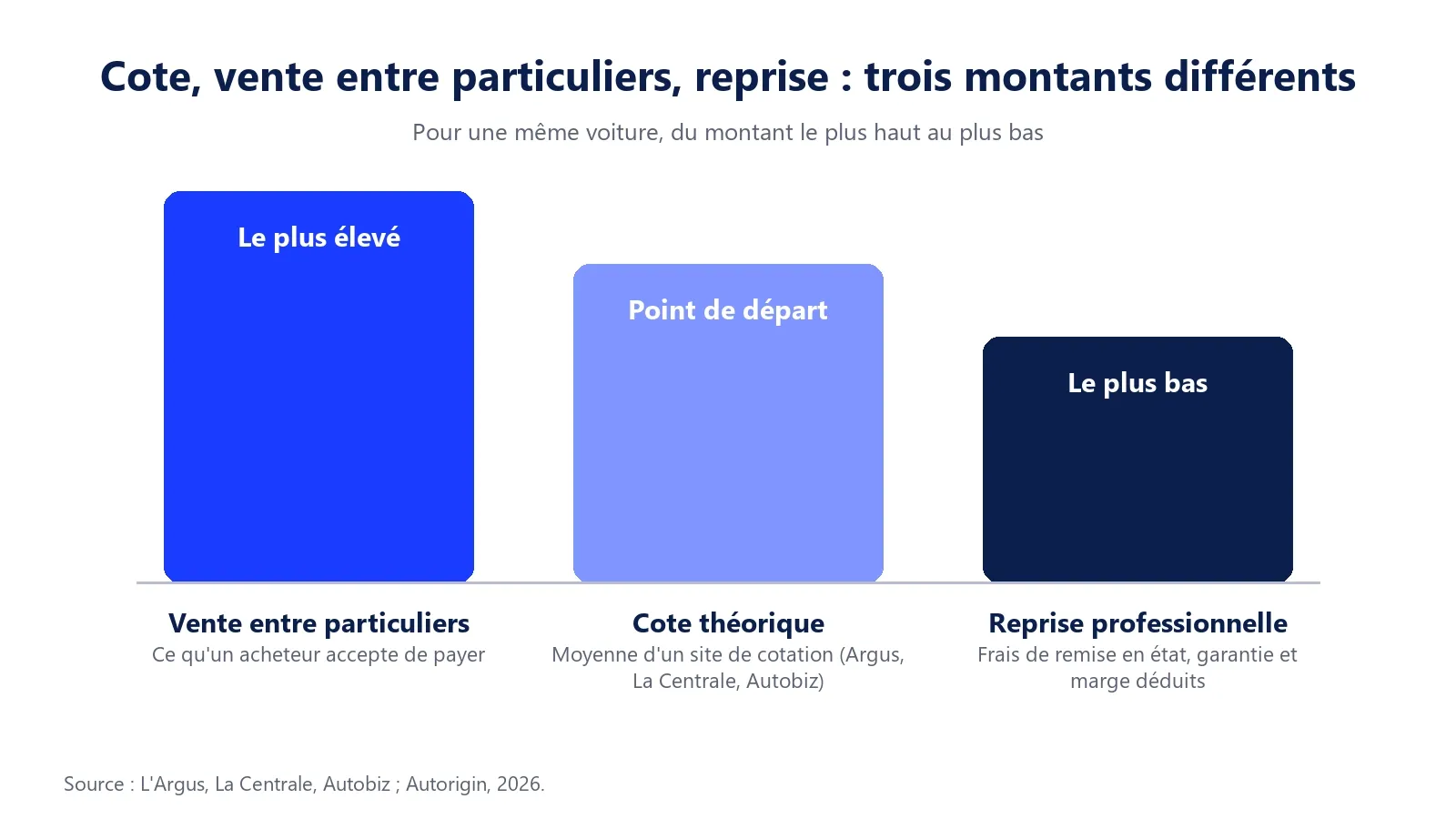
The concept of car valuation actually covers three notions:
- Theoretical valuation: the average calculated by a valuation website (Argus valuation, La Centrale valuation, Autobiz).
- Private sale price: what a buyer is willing to pay, generally the highest.
- Trade-in amount: what a professional offers to buy the car. This includes their refurbishment costs, warranty and margin.
The valuation is therefore a starting point, not a final price. Your job is to adjust it with verified facts.
Source: L'Argus, La Centrale, Autobiz; Autorigin, 2026
Why valuation matters so much today
The used car market remains very active in France. According to the SDES, the statistics department of the Ministry for the Ecological Transition, 5.5 million used cars were sold in 2025, an increase of 0.9% in one year. With such volume, trends evolve quickly: an assessment a few months old may already be outdated.
The vehicle fleet is also ageing. According to the SDES, the average age of cars on the road reached 11.8 years as of 1 January 2026. The older a car is, the more its wear and history affect its value, to the detriment of the theoretical valuation.
How is a car's valuation calculated?
Not all valuation tools use the same data. Two main methods coexist, and they explain most of the differences between websites.
The experts' method: the depreciation curve
The Argus valuation starts from the new catalogue price of the model. Expert valuers apply a depreciation curve specific to each engine and trim, adjusted throughout the model's life. They rely on the actual trade-in, buy-back and resale values practised in dealerships.
The result is an Average Argus Value, calculated for a car registered mid-year with standard mileage. The personalised valuation then adjusts this value according to the registration date, mileage and options.
The statistical method: analysing listings
The La Centrale valuation and the Autobiz valuation are mainly based on market observation. Autobiz states that it analyses around 2 million listings every day to track supply and demand, taking into account the make, model, engine, body type and mileage. La Centrale similarly relies on listings from its platform.
This method reacts quickly to trends, but it measures asking prices, not completed sales. A valuation can therefore be pushed up by overvalued listings.
Why does a car's valuation decrease over time?
Depreciation is greatest at the start of a vehicle's life. A new car generally loses between 15 and 30% of its value in the first year, depending on the make and model, and some models lose nearly half their value after three years. The decrease then slows, but continues with age, mileage and the arrival of new generations.
Can a car's valuation go back up?
Yes, in specific cases. A model that has become rare or sought-after, such as certain sporty youngtimers, can regain value after 10 to 15 years, provided it is original and well maintained. Tension in the used car market can also temporarily push up the valuations of highly sought-after models. For a common car, the trend remains downward.
Argus, La Centrale, Autobiz: valuation tools
Several websites allow you to calculate a car's valuation. Each applies its own method, which explains why the results never match perfectly.
The Argus valuation
The Argus valuation is the historical reference in France, originating from the L'Argus newspaper founded in 1927. Professionals, insurers and notaries use it widely. The L'Argus website displays an indicative range, but the detailed Argus valuation remains paid-for. Many refer to a 'free Argus valuation' when it is only a rough estimate. In fact, there is no official valuation set by the authorities.
A point often misunderstood: L'Argus presents its valuation as an estimate of the trade-in price by a professional. It serves as a basis for negotiation with a garage, but does not correspond to the amount to display in a private sale advert, which will generally be higher.
The La Centrale valuation
The La Centrale valuation is free, with no commitment and widely consulted. It can be calculated by registration or by model. It is based on the market knowledge of the listings platform and rather reflects a private sale amount.
Autobiz, Turbo and other platforms
Other players offer a free online estimate. The Autobiz valuation has the particularity of displaying two amounts, one for a sale to a professional, the other for a sale to a private individual. There is also the Turbo valuation, or buy-back sites such as Vendezvotrevoiture. These services are quick, but some require registration and are mainly used to generate a purchase offer. The figure displayed then corresponds to a trade-in, not a resale.
| Tool | Access | Estimated amount | Takes history into account |
|---|---|---|---|
| Argus valuation | Free range, detailed version paid-for | Trade-in by a professional | No, self-declared entry |
| La Centrale valuation | Free | Private sale | Limited |
| Autobiz valuation | Free | Two valuations: professional and private | No, self-declared entry |
| Express buy-back sites | Free, registration often required | Trade-in offer | Only after inspection |
| Autorigin report | Paid-for | Market range adjusted to the vehicle | Yes: accidents, mileage, owners, maintenance |
Except for the history report, none of these tools knows the real history of your car. They are based on what you declare. This is why a serious assessment should cross-check several sources.
The criteria that determine your car's valuation
To estimate a vehicle without outside help, you need to understand what makes its price go up or down. Here are the points to review.
The make and model
The make and model set the starting level. Very popular city cars such as the Renault Clio, Peugeot 208, Citroën C3, Volkswagen Polo or Dacia Sandero are easy to sell. A new Dacia has a low price, which limits the loss in euros. The arrival of new models can also affect previous generations. Conversely, a BMW or Mercedes starts from a higher new price and often loses more in absolute value: this is depreciation. The reputation of an engine or a model generation also plays a role.
The year of first registration
The date of first registration appears on the carte grise (French registration certificate). It determines the car's age, and therefore its depreciation: the loss in value is greatest during the first years. To read it correctly, see our article on how to find out a car's registration date.
Mileage
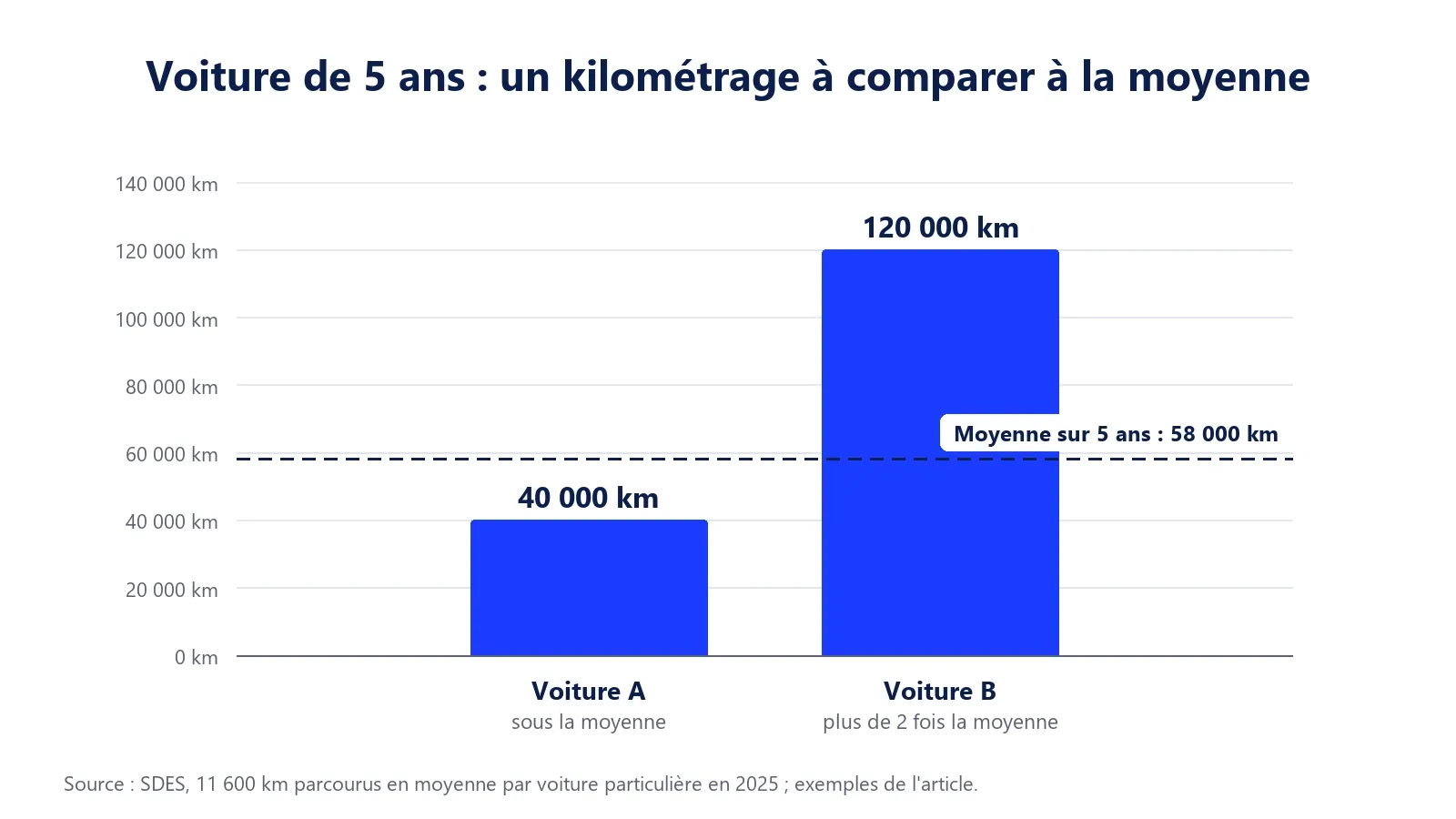
The odometer is one of the most decisive criteria. To know if yours is high, compare it to the average: according to the SDES, a private car covered an average of 11,600 km in 2025. A 5-year-old car with 40,000 km is therefore below average, another of the same age with 120,000 km is well above.
A low odometer reading is only an asset if it is reliable and verifiable. Fraud exists, and an inconsistent reading will put off buyers.

Source: SDES, average mileage 2025 (11,600 km per year)
The engine and fuel type
Petrol, diesel, hybrid or electric: the engine type strongly influences demand. Restrictions in large urban areas, linked to Crit'Air stickers, accelerate the depreciation of older diesels. A turbo known to be fragile on a given generation can also affect the price.
Trim and equipment
Two examples of an identical model can be very differently equipped. A high-end trim, a sunroof or driving aids increase the price, even though these options are never fully reflected in the resale value. To find the exact version, read our guide on how to find a car's trim level using its registration number.
Wear and maintenance
Bodywork, upholstery, tyres, brakes: every defect means costs for the future owner. A complete service book, with supporting invoices, is reassuring and justifies a higher valuation. On the other hand, patchy maintenance history becomes a bargaining point.
History
Accidents, number of owners, previous use (rental, taxi, fleet), administrative status: the history is what valuation tools do not see. Yet this is often where the biggest gaps between the valuation and reality are found.
Region and season
An identical car does not always sell for the same price in Paris, Lyon or Bordeaux: local demand, available supply and traffic regulations all affect the valuation. A convertible sells better in spring, a 4x4 before winter. Looking at listings in your region, both in urban and rural areas, gives a more accurate picture than the national average alone.
How to estimate your car's value in 6 steps
Here is a quick method to assess your vehicle independently.
Source: Autorigin, 2026
Step 1: gather the exact information
Collect the carte grise (French registration certificate), the odometer reading, the trim level, the service book, invoices and the latest MOT test report. An accurate valuation starts with accurate data: a mistake in trim or engine can skew the result by several hundred euros.
Step 2: check two or three initial valuations
Consult at least two websites, for example the La Centrale valuation and the price range from L'Argus or Autobiz. Simply enter the model in the search field. The aim is not to pick the most flattering valuation, but to establish a base range.
Step 3: compare with the real market
Find about ten identical or very similar cars online: same engine, comparable age and mileage. Note their prices.
An online listing shows an asking price, not the final sale price. The Autobiz barometer from October 2025, based on AAA Data figures, showed an average gap of €242 between advertised prices and market value in September 2025. A car listed online for weeks is often overpriced.
Step 4: adjust for wear
Make an honest assessment of your car compared to this sample:
- Tyres or brakes need replacing: deduct the cost of parts and labour.
- Scratches, dents, damaged alloys: deduct the cost of repairs.
- Recent timing belt, regular servicing by the manufacturer: aim for the top of the range.
- MOT with faults: include the cost of repairs.
Step 5: check the history
This is the most often overlooked step. An old accident, an inconsistent odometer or previous rental use all make a difference, even on a car that looks perfect. A history report allows you to check this objectively.
Step 6: set your final price range
You now have a theoretical valuation, an observed market level and concrete adjustments. Define:
- a displayed price, slightly above your target to allow for negotiation;
- a bottom threshold, below which you will not sell.
For the buyer, the process is identical: it gives a fair price to offer and factual arguments.
Electric, hybrid, commercial, classic cars: special cases
Certain categories are not valued like a petrol city car.
The valuation of an electric car
For an electric car, the main criterion is the battery's condition. A degraded battery reduces the real range and the appeal of the vehicle. Traditional valuations do not yet fully take this parameter into account.
The sector is progressing, however: according to Auto Infos, sales of used electric cars jumped by 30.34% between 2024 and 2025 in France. To accurately value an electric car, request a battery health certificate and compare the stated range with that observed during a test drive.
Hybrid and commercial vehicles
For a hybrid, examine both the combustion engine and the traction battery. For a commercial vehicle, often bought by professionals, the price depends on the usable volume, fittings and the (often high) mileage. Usage history is very important: a fleet commercial vehicle may have been heavily used.
Classic car
A classic car is largely outside the scope of automatic tools. Its price depends on rarity, authenticity and documentation. A professional appraisal by a specialist expert or auction results are then more relevant than a generic valuation.
Using the Autorigin report to refine your estimate
Valuation tools provide an average. The Autorigin report provides the facts that place your car above or below this average.
An estimate based on the market and history
The Autorigin report includes a vehicle estimate based on current listings for similar models. It takes into account the car's history, mileage and wear to suggest a realistic price range. Unlike a declarative valuation, it is not based solely on what the seller claims.
The sections that influence the value
- Accidents: declared incidents, including those in 16 covered European countries. A hidden accident is one of the main causes of overpayment.
- Mileage: readings at each inspection point, with any inconsistencies flagged.
- Owners: their number, length of ownership and intensive uses (taxi, rental, demonstration).
- Servicing: interventions, repairs and replaced parts.
- Legal status: theft, outstanding finance, pledge, write-off, manufacturer recalls.
- Trim and options: for most brands, the exact trim and fitted equipment, with the amount spent on these options at order.
Discovering a sample Autorigin report shows how this information is presented.
How to use it in practice
Selling? A clean history, verified mileage and a single owner justify the top of the price range. Share the report link with every enquiry: new buyers decide more quickly.
Buying?
With Autorigin, access the essential information to better understand a car's past.
Get a history report