
Check its history before you commit.
The 1.2 PureTech has a mixed reputation: praised at launch for its efficiency, it was later criticised for its oil-immersed timing belt, which caused serious breakdowns. More recent units have been made more reliable by Stellantis. Our opinion is nuanced: if well maintained, this engine remains a good choice, but when buying second-hand, everything depends on its maintenance history. Here are the known problems, the versions to avoid and how to inspect the car before buying.
What is the PureTech engine?
The PureTech is a family of turbocharged 3-cylinder petrol engines from the PSA group, now Stellantis. The 1.2, the most widespread, has equipped many Peugeot, Citroën, DS and Opel models since 2014, from city cars to compact SUVs.
At its launch, this engine won several awards for its efficiency and low fuel consumption. Economical at the pump, it was long a selling point, with satisfied owners. This reputation was later tarnished by a reliability defect, leading to many negative reviews and manufacturer recall campaigns.
An award-winning petrol engine, fitted to which models?
It can be found in the Peugeot 208, 2008, 308 and 3008, the Citroën C3, C4 and C5 Aircross, the DS 3 and DS 4, as well as several Opels such as the Corsa and Mokka. It comes in PureTech 82, PureTech 110 and PureTech 130 versions, depending on the generation and vehicle. Economical and efficient, it has won over many drivers in France.
PureTech problems: immersed belt and excessive oil consumption
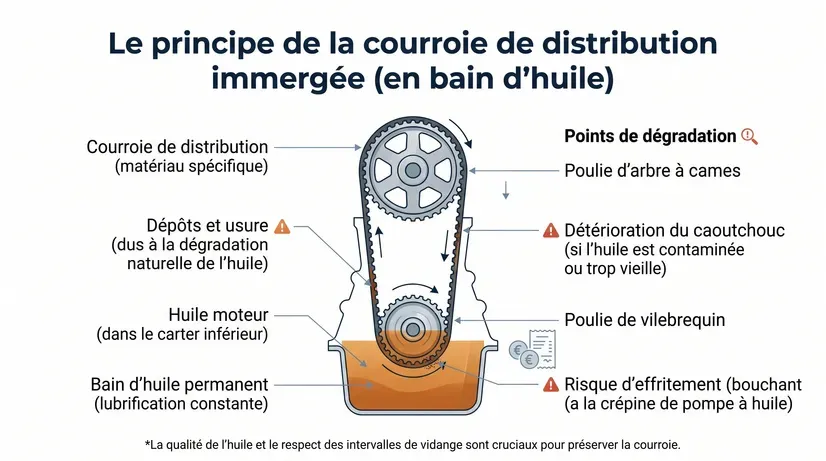
The main problem comes from the oil-immersed timing belt, a wet belt bathed in engine oil. As it ages, it deteriorates and releases particles that clog the lubrication circuit, with a risk of engine failure.
The defect of the immersed part
On units equipped with this system, it breaks down before the theoretical interval. The debris blocks the oil pump strainer and deprives the engine of lubrication. According to the specialist press and owner feedback, the defect mainly affects the first generations, before technical improvements.
Preventive maintenance reduces the risk but does not eliminate it on the affected models. The UFC-Que Choisir association has reported many accounts from drivers facing costly repairs, sometimes major repairs or even engine replacement. The cost of such an intervention can be high.
Excessive oil consumption and risk of breakdown
The second issue: excessive oil consumption on certain units. Driving with too low a level accelerates wear and exposes the engine to serious failure. Regularly checking the level and keeping up with oil changes are therefore essential. Early clogging is sometimes observed.
Which PureTech versions should you avoid and which are reliable?
Not all variants present the same risk. The difference lies in the type of drive: generations with an oil-immersed belt require vigilance, while more recent versions have been made more reliable. Talking about PureTech engines to avoid only makes sense in terms of the generation. The comparison below summarises the situation.
| Version | Generation | Timing system | Vigilance |
|---|---|---|---|
| 1.2 PureTech 82 | EB2, naturally aspirated or turbo depending on the model | Oil-immersed belt on the turbo | High on the early years |
| 1.2 PureTech 110 | EB2DT then evolutions | Immersed (oil bath) | High before reliability improvements |
| 1.2 PureTech 130 | EB2ADT then evolutions | Immersed then improved | Medium, depending on age and maintenance |
| New generation | Latest Stellantis evolution | Timing chain | Reduced, to be confirmed depending on model year |
The production years and details of the changes vary depending on the model: to be checked case by case. According to Stellantis and the specialist press, the most recent units have abandoned the immersed part in favour of a timing chain, considered more durable. A reliable engine is above all a matter of proper maintenance, not simply avoiding a particular model.
Immersed belt or new system: how to tell
The model year and engine type are crucial. You can use the VIN number to identify the exact unit: our VIN decoder confirms the engine and year before any commitment.
How to check a used PureTech before buying
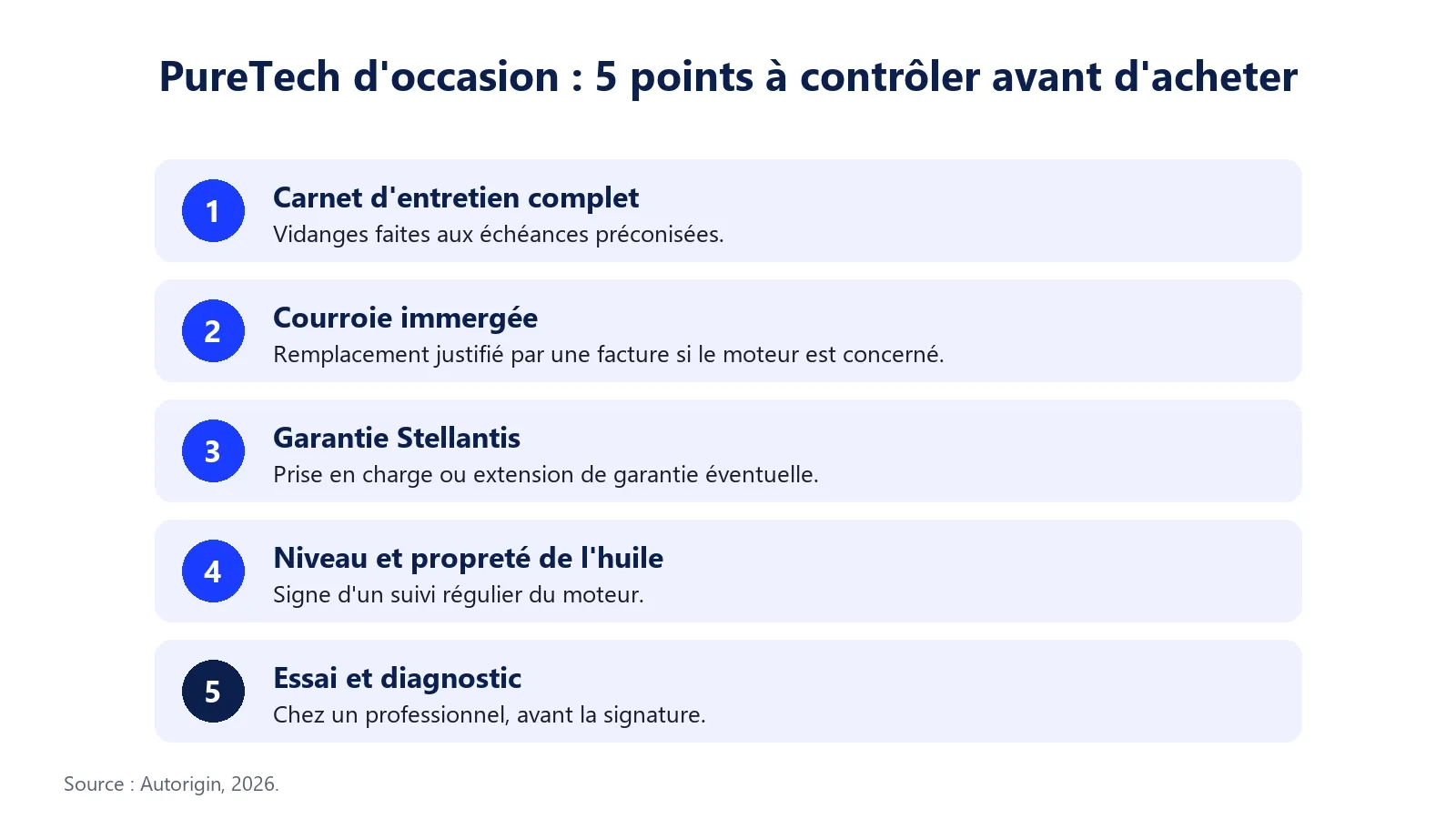
When buying, it is not the model itself you should fear, but its maintenance history. A complete service book and up-to-date maintenance invoices are more important than a general opinion. Points to check before buying:
- the complete service book, with oil changes carried out at the recommended intervals;
- replacement of the immersed part if the vehicle is affected, with supporting evidence;
- any Stellantis support or extended warranty;
- the oil level and cleanliness, a sign of regular maintenance;
- a test drive and mechanical inspection by a professional before signing.
Maintenance history: the decisive criterion
A unit with timely oil changes, where this point has been checked or the part replaced, inspires much more confidence than a car with no traceability. The private sale purchase checklist summarises the other points. Before signing, you can check the vehicle's maintenance history using its number plate or VIN.
A report remains a document: it complements, but does not replace, a mechanic's inspection and a road test.
Used PureTech: check before you decide
The 1.2 PureTech suffered a real issue with the immersed belt on its early units, but the mechanics have been improved and the latest generation uses a new drive system. If properly maintained, it remains an economical and pleasant engine.
When buying second-hand, maintenance makes all the difference. Before deciding, you can check a PureTech before buying using its history.
With Autorigin, access the essential information to better understand a car's past.
Get a history report