
Check its history before you commit.
A vehicle with no encumbrance is a vehicle on which no encumbrance is registered: no credit institution holds any security over it. The proof is the certificat de situation administrative, the former certificat de non gage, which the seller must provide to the buyer before the sale, dated within the last 15 days.
According to Service Public, this document also indicates any restrictions on the transfer of the certificat d'immatriculation, which block the sale until they are lifted. For the buyer of a used car, knowing how to read it avoids committing to a vehicle that cannot be registered in their name. Here is how the seller obtains it on HistoVec, how to read each entry, and what to check before paying.
What does "non gagé" mean for a vehicle?
By definition, a vehicle with no encumbrance is free from any lender's security. Its administrative status confirms this, provided you also check the other possible entry: the restriction.
The encumbrance, a lender's security
An encumbrance is a security taken by a credit institution when a vehicle is financed by a loan. The registration remains in place until the loan is fully repaid. Once the loan is settled, the financial institution removes it, according to administration form F1360.
A vehicle with an encumbrance is therefore neither stolen nor damaged. It is a vehicle whose financing is not yet complete, a common situation on the used car market.
Encumbrance and restriction: two entries not to be confused
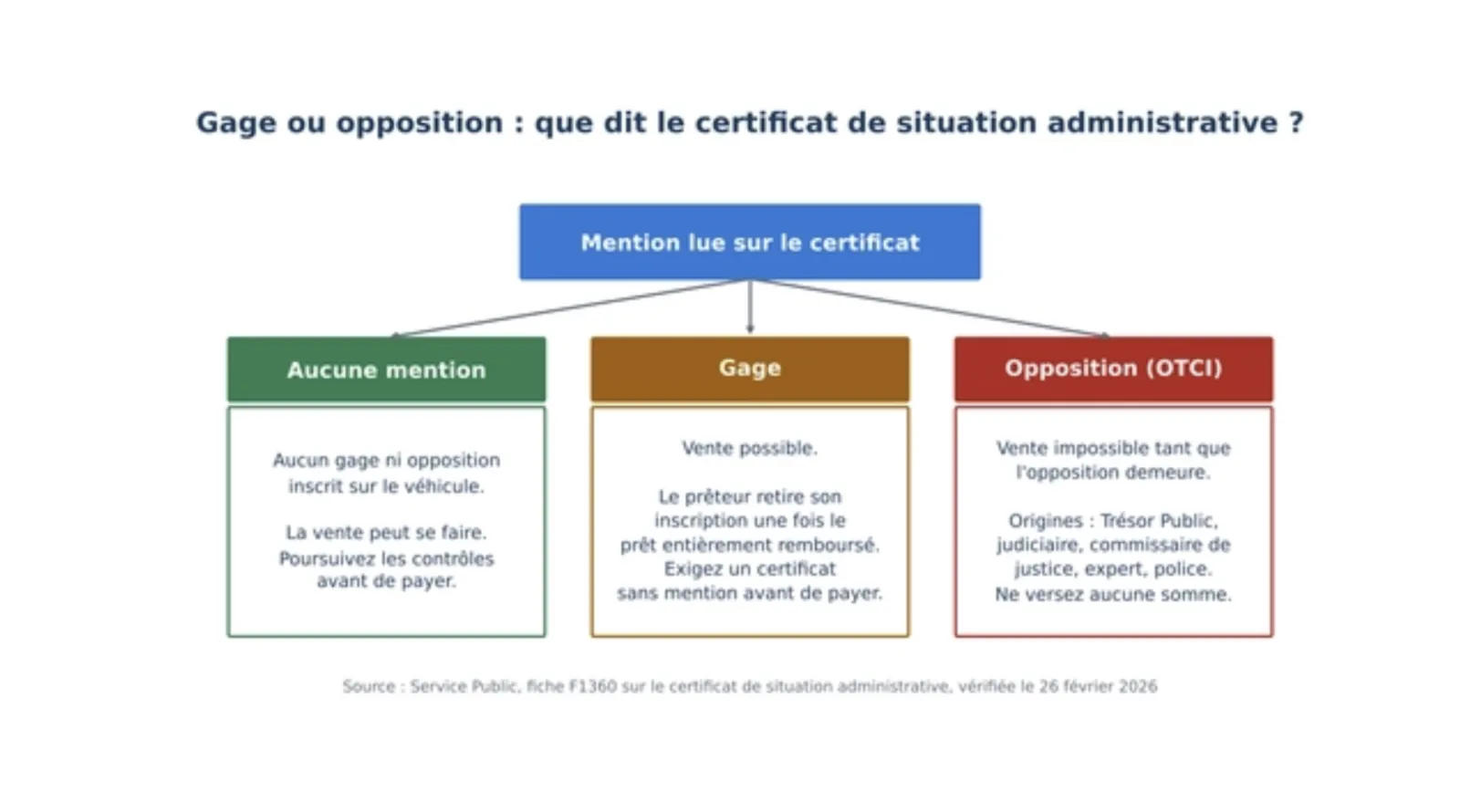
The certificat de situation administrative includes two types of entries: the encumbrance and the restriction on the transfer of the certificat d'immatriculation, known as OTCI. Their consequences for the sale of a vehicle are different.
- Encumbrance: the sale remains possible, according to Service Public. However, the lender only removes their registration once the loan is repaid.
- Restriction (OTCI): the sale is impossible as long as the restriction remains.
In practice, the mention "non gagé" in an advert is therefore not enough. A vehicle may be free from any financing but subject to a restriction: only the certificate allows you to read both pieces of information.
The certificat de non gage: what replaces it and how to obtain it
This certificate is now called the certificat de situation administrative, or CSA. It indicates whether a vehicle is encumbered or subject to a restriction on the transfer of its certificat d'immatriculation.
The certificat de situation administrative, official document
The CSA has replaced the former certificate and brings together both useful pieces of information. It is not issued for a vehicle registered abroad, according to the administration.
In adverts, you may still see "attestation de non gage". The name has changed, but the question remains the same: can the vehicle change owner without any blockage?
Obligatory for the seller, valid for 15 days
Providing the certificate is an obligation. For a used vehicle already registered in France, the owner wishing to sell their car must give it to the buyer before the transfer. The rule is set out in Service Public form F1360, checked on 26 February 2026.
The certificate must be dated within the last 15 days at the time it is handed over. An older certificate may no longer reflect the vehicle's situation: a registration may have appeared in the meantime.
How the seller gives the certificate to the buyer
Form F1360 provides two ways to give the certificate: print out the report and hand it over in person, or share an online consultation link. In both cases, check the date of the certificate and the registration number.
How to read the entries on the certificat de situation administrative
The certificat de situation administrative indicates either the absence of encumbrance and restriction, or one or more entries. Each entry has a specific origin and a direct consequence for the sale.
| Entry | Origin | Consequence for the sale | How to lift it |
|---|---|---|---|
| Encumbrance | Financial institution (vehicle financed by a loan) | Sale possible | Full repayment of the loan; in leasing, taking over the balance may sometimes be accepted |
| OTCI Trésor Public | Unpaid fines or address not updated | Sale impossible | Payment of the amounts due; updating the address |
| OTCI judicial | Vehicle registered in the file of reported objects and vehicles (FOVeS) | Sale impossible | None while the registration remains; automatic removal when the vehicle is returned |
| OTCI judicial officer | Seizure | Sale impossible | Generally, payment of the claimed amount |
| OTCI automotive expert | Vehicle economically irreparable (VEI) or seriously damaged (VGE) | Transfer possible only to a dismantler | New assessment |
| OTCI judicial police | Offence liable to confiscation | Sale impossible | Case closed without further action, dismissal, acquittal or absence of confiscation |
The reading is therefore straightforward. An encumbrance entry calls for a discussion about repaying the loan; a restriction on transfer blocks the transaction as long as it remains.
Each origin of OTCI follows its own procedure. Our article on restrictions on the transfer of the certificat d'immatriculation details each of them.
Buying a used car: checking for non-encumbrance before paying
Before paying for a used vehicle, demand a recent certificat de situation administrative and check that it matches the vehicle. This check takes a few minutes and strengthens the buyer's protection at the time of changing ownership.
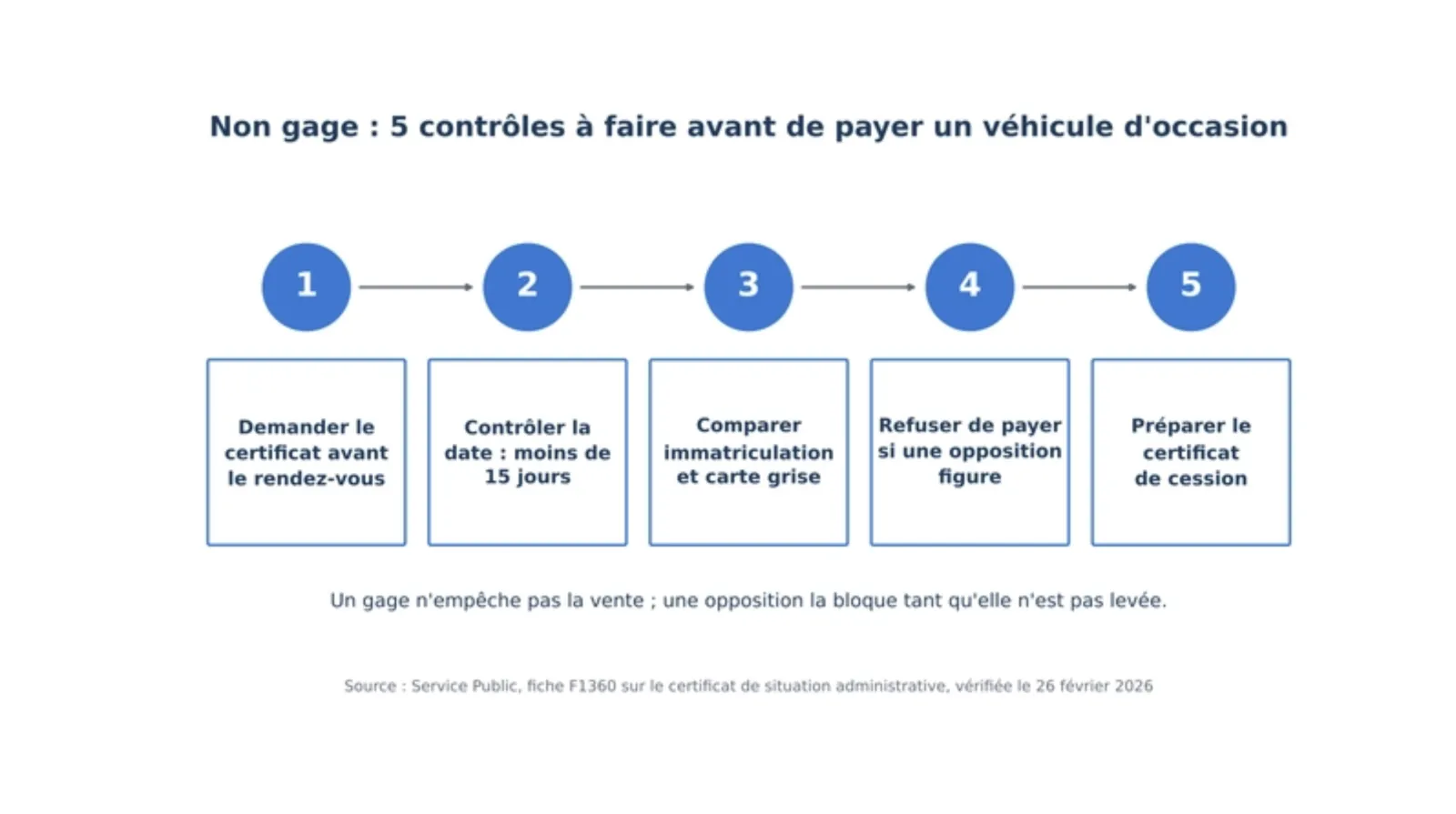
The 5 checks to make before payment
Each step is carried out before any money is handed over:
- Ask for the certificate, or the consultation link, before the appointment. If you do not have the carte grise to hand, find out how to check if a vehicle is encumbered without the carte grise.
- Check the date of the certificate: if it is beyond the validity period set by the administration, ask for a new one to be issued.
- Compare the registration number on the certificate with that on the carte grise and the plate, then the date of first registration with that in the advert.
- Refuse to pay if a restriction appears on the certificate: the sale is impossible as long as it remains.
- Prepare the transfer certificate, which will allow the change of owner on the carte grise.
"The certificat de situation administrative should be requested before the appointment, not at the time of payment. Demand a recent one, compare it with the carte grise, then complete with the vehicle's history," explains Nicolas Bermejo, project manager at Autorigin.
An old or inconsistent certificate: warning signs
A certificate dated several weeks ago, a registration number different from the plate, or a certificate that the seller refuses to show before the appointment are warning signs. In these cases, ask for a new certificate to be issued before handing over any money.
These signs add to the other pitfalls of private sales, described in our guide to avoiding used car scams.
What the Autorigin history report adds
The certificat de situation administrative answers one question: can the vehicle change owner? The Autorigin history report complements this answer with the vehicle's past: recorded mileage, declared claims and administrative status, including encumbrance and restrictions, when this data is available.
The report only includes information officially recorded. It does not replace the certificate issued by the administration and does not identify the vehicle's owner.
See the vehicle's history
Vehicle with encumbrance or restriction: what to do?
If the certificate mentions an encumbrance or a restriction, do not pay any money until the situation is resolved. It is up to the vehicle's owner to have the entry removed, not the buyer.
Lifting an encumbrance
To lift an encumbrance, the loan must be fully repaid: the financial institution then removes the entry. In leasing, the finance company may sometimes accept the sale if the buyer takes over the balance of the contract.
Before going any further, ask for a new certificate with no entries. Our article on registering a vehicle with an encumbrance details the possible situations.
Lifting a restriction
The procedure depends on the origin of the restriction:
- Trésor Public: pay the relevant fines and declare any change of address within one month of moving.
- Judicial officer: obtain the lifting of the restriction from them, generally by paying the claimed amount.
- Automotive expert: have a new assessment of the vehicle carried out.
- Registration in FOVeS: no lifting possible as long as the vehicle remains registered.
- Judicial police: lifting possible if the case is closed without further action, dismissed, acquitted or there is no confiscation.
The legal framework is set out in the Code de la route, articles L330-1 to L330-8.
Key points
- A vehicle with no encumbrance has no encumbrance registered; the proof is the certificat de situation administrative (formerly certificat de non gage).
- The seller must provide it before the sale, dated within the last 15 days.
- With an encumbrance, the sale remains possible; with a restriction, it is impossible until it is lifted.
Before paying: certificate less than 15 days old and vehicle history
A vehicle with no encumbrance is one with no registered lien, and the certificat de situation administrative provides proof of this. The owner must provide it before the sale; the CSA also indicates any oppositions that block the transfer. Demanding this certificate, reading it carefully and comparing it with the carte grise significantly reduces administrative risk. Whether the sale is between private individuals or through a professional, the decision should be made only after this check.
To go further than the administrative status, the Autorigin history report traces the vehicle's past based on officially recorded information.
Check the history before buying
Sources
- Service Public, F1360 information sheet: certificat de situation administrative (formerly certificat de non-gage), checked on 26 February 2026
- Code de la route, articles L330-1 to L330-8 and R322-1 to R322-14 (references cited by the F1360 information sheet)
- Order of 9 February 2009 relating to vehicle registration procedures (reference cited by the F1360 information sheet)
- HistoVec online service, Ministry of the Interior
With Autorigin, access the essential information to better understand a car's past.
Get a history report