
Check its history before you commit.
To find out if a vehicle is insured, consult the Fichier des Véhicules Assurés (FVA), the national database managed by AGIRA and in operation since 1 January 2019. Since 1 April 2024, this database replaces the green card as proof of insurance for registered vehicles, according to Service Public. This check is useful before buying a used car, lending or renting a vehicle. Here is what the FVA is, how to consult it, which documents prove car insurance, and what a driver risks without insurance. One limitation to keep in mind: insurance says nothing about the vehicle's history (claims, administrative status).
How to check if a vehicle is insured? The FVA
To find out if a vehicle is insured, you need to consult the Fichier des Véhicules Assurés, which is accessible online from the official FVA website. The database indicates whether a car insurance policy covers the vehicle on a given date.
What is the FVA (Fichier des Véhicules Assurés)?
The FVA is a national database that centralises the insurance cover of all vehicles registered in France. Provided for by the Law on the Modernisation of Justice in the 21st Century of 18 November 2016, it has been in operation since 1 January 2019, according to AGIRA.
For each insured vehicle, the database records 4 pieces of information:
- the registration number;
- the name of the insurer;
- the insurance policy number;
- the validity period of the policy.
In terms of data protection, the FVA contains no directly identifying data: no surname, first name, or contact details. The data is encrypted, access is logged, and everything is kept for 7 years, according to AGIRA.
Objectives and operation of the FVA: the role of AGIRA
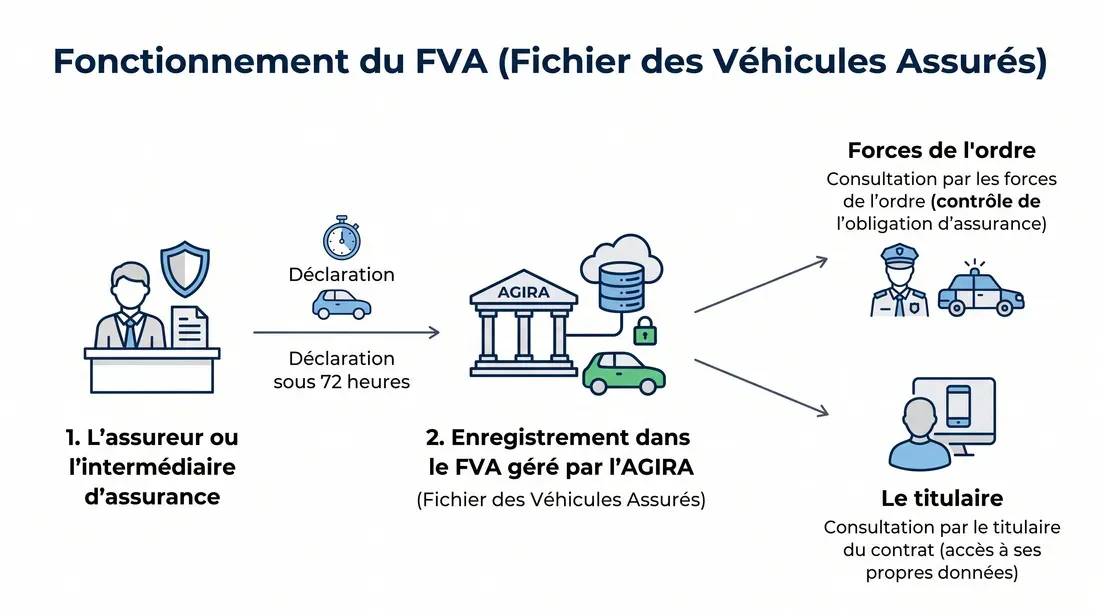
The main objectives of the FVA are to combat lack of insurance and to assist law enforcement in their control duties. The database also supports prevention work by the Guarantee Fund (FGAO). It helps identify vehicles in cases of hit-and-run, theft or trafficking, and allows each policyholder to check the status of their vehicle.
The management of the FVA has been entrusted to AGIRA, the Association for the Management of Insurance Risk Information. Insurance companies and their intermediaries feed the database by making a declaration, within a maximum of 72 hours after the start or end of the motor third-party liability cover. The rules for the database are set out in Article L451-1-1 of the Insurance Code.
Source: AGIRA, 2026.
Which vehicles must be registered in the FVA?
Every registered motor vehicle, usually parked on French territory and subject to the legal requirement for third-party liability insurance (often called third-party insurance), must be listed in the FVA, according to AGIRA. Service Public reminds us that every motor vehicle must be insured, even when not in use.
Unregistered vehicles subject to insurance, such as light mopeds, are not included: their proof of insurance remains a paper document.
Who can consult the FVA, and how?
The holder of a policy can consult the FVA online at consultation-fva.fr, the official process referenced by Service Public. The check is carried out by entering the vehicle's registration number or certain details from the registration certificate or insurance policy.
The steps are as follows:
Go to the consultation-fva.fr website, accessible from the “Consulter la situation de mon véhicule dans le FVA” section of the AGIRA website.
Select the vehicle's registration format and enter the number plate.
Complete the requested information, taken from the carte grise or the policy.
Validate to display the vehicle's status in the database.
This check allows you to verify your own vehicle, or a used vehicle for which the seller shows you the registration certificate. Law enforcement consult the FVA during roadside checks.
Checking your own insurance or that of a third party after an accident
Checking the validity date of your own insurance is useful after changing insurer, as the database update can take up to 72 hours. This is also a good habit before lending a car: in the event of an accident, the driver is responsible even if they are not the owner of the vehicle.
After an accident, you do not have access to the other party's information in the FVA. The amicable accident report indicates the insurer and the policy reference for each driver.
Documents and procedures to prove insurance
Since 1 April 2024, proof of insurance for a registered vehicle is provided by the FVA, and no longer by the green card, according to Service Public. Other documents remain useful to justify car insurance or to trace your driving history.
Insurance certificate and green card: what are they for?
Until 1 April 2024, the green card included a certificate kept in the vehicle and a sticker affixed to the windscreen. Since then, the green card is no longer issued or required for registered vehicles. For 15 days after taking out a policy, the document provided by the insurer is valid, while the policy declaration is being processed in the database.
| Type of vehicle | Proof of insurance | In case of a check |
|---|---|---|
| Registered vehicle (car, motorbike) | Entry in the FVA, or document from the insurer valid for 15 days after taking out the policy | Law enforcement consult the FVA |
| Unregistered vehicle subject to insurance (light moped, EDPM, ride-on mower) | Green card on white paper and certificate affixed to the vehicle within 15 days | Certificate to be presented (international insurance card abroad); if not, €35 fine and 5 days to produce it |
For a registered car or motorbike, the paper insurance certificate is therefore no longer daily proof of cover: the database is now the reference.
The information statement: what it is and how to obtain it
The information statement is a key document for insurance policies, required when changing insurer. It records your driving history over the past five years:
- the bonus-malus coefficient;
- declared claims and your liability;
- the dates the policy was taken out and cancelled.
To obtain an information statement, request it from your insurer or broker, or from your online customer area. The new insurance company uses it to calculate your premium: a bonus reduces it, a malus increases it.
For a young driver or after cancellation by the company, this statement is significant: it records the reason for cancellation, which can make it harder to take out a new policy.
Beware of fake information statements
Because it affects the price of a car or motorbike insurance policy, the information statement is sometimes falsified to hide a malus or claims. A genuine statement bears the insurer's letterhead, a policy number and their contact details. Be wary of:
- a statement without a logo;
- inconsistent dates;
- a bonus-malus coefficient that does not match the declared driving experience.
If in doubt, cross-check the information statement with the issuing insurer.
Driving without insurance: risks and checks before buying
Driving without insurance is an offence under the Highway Code, not just a simple fine. The driver risks a fine of up to €3,750, immobilisation of the vehicle and additional penalties, according to Service Public (2026).
The risks and penalties for driving without insurance
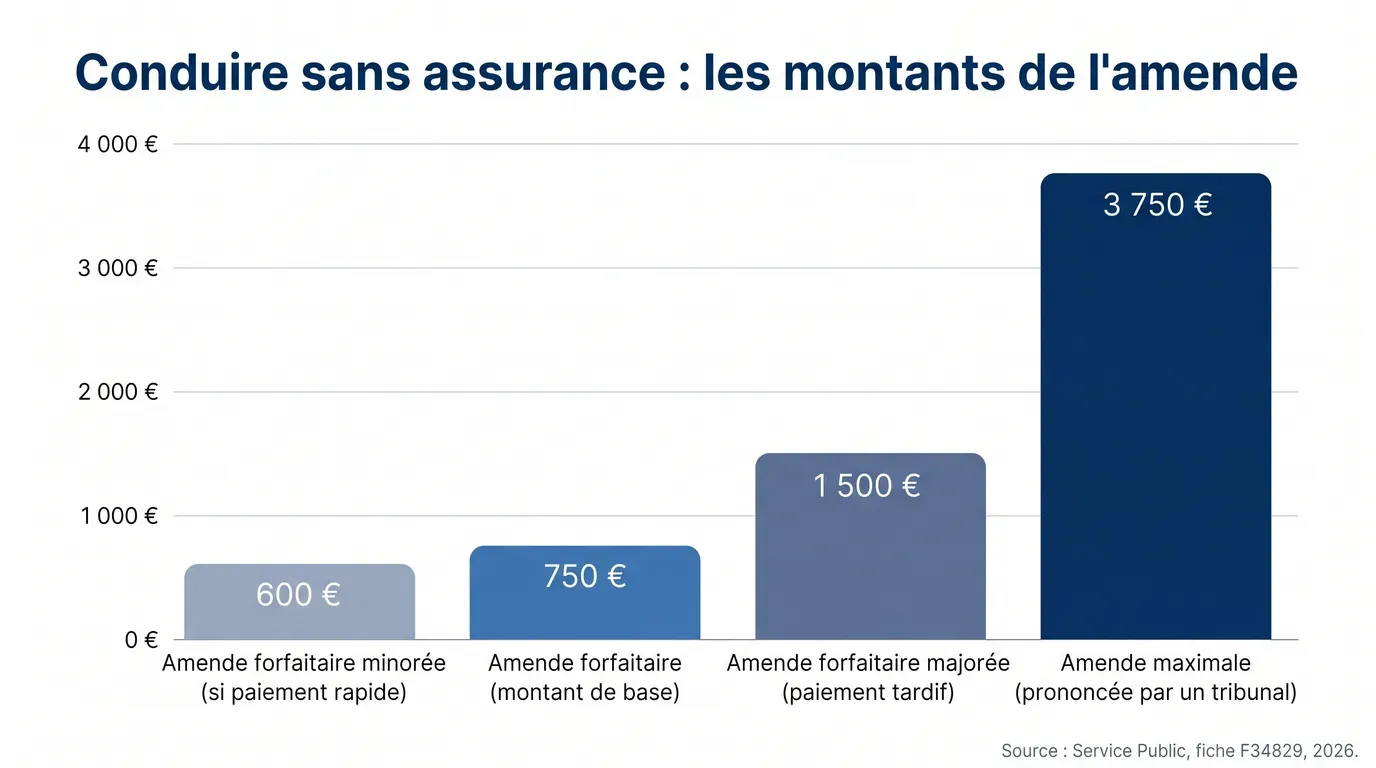
Putting or keeping a motor vehicle in circulation without insurance is punishable by a fine of up to €3,750 in court. For a first offence recorded by electronic report, a fixed fine may apply, increased by 50% for the benefit of the FGAO:
| Situation | Fine | FGAO increase | Total to pay |
|---|---|---|---|
| Immediate payment or within 15 days (reduced fine) | €400 | €200 | €600 |
| Payment within 45 days (fixed fine) | €500 | €250 | €750 |
| Payment after 45 days (increased fine) | €1,000 | €500 | €1,500 |
| Court judgement | Up to €3,750 | Not applicable | Up to €3,750 |
Additional penalties include suspension of the driving licence for up to 3 years, cancellation, a road safety course and confiscation of the vehicle. A vehicle caught speeding at 50 km/h or more above the limit also has its FVA entry checked automatically.
The risk is also financial: after a responsible road accident, the Guarantee Fund compensates the victims, then seeks reimbursement from the uninsured driver. The driver must repay the compensation paid, with no cover for their own damage.
Source: Service Public, fiche F34829, 2026.
Before buying: checking insurance is not enough, check the full history
For a used car, knowing it is insured is reassuring, but only part of the picture. The FVA confirms cover at a given moment, not the vehicle's history.
It is the history that often holds surprises. A history report, depending on available data, sheds light on declared claims, mileage records and the vehicle's administrative status: loan, restriction or theft. Find out how the check works using a registration number, then check the vehicle's history.
Before making a purchase, also find out about your rights regarding a used car, consider manufacturer recalls and follow the private sale purchase checklist.
Buy with peace of mind: check everything before signing
The FVA shows in just a few steps whether a registered vehicle is insured, and it has replaced the green card since 1 April 2024. Driving without insurance carries a minimum fixed fine of 600 euros, and up to 3,750 euros in court.
An insured vehicle is not necessarily a vehicle without a history. Before signing, look into its past: claims, mileage, administrative status. View a sample history report, then check a vehicle with Autorigin before committing.
Sources
- AGIRA, Le FVA (origin, objectives, launched on 1 January 2019), consulted on 15 October 2026: https://www.fva-assurance.fr/le-fva/
- AGIRA, Fonctionnement du FVA (72 hours, 7 years, recorded data), consulted on 15 October 2026: https://www.fva-assurance.fr/fonctionnement/
- Service Public, How to prove that a motor vehicle is insured? (sheet F1362), checked on 10 April 2026: https://www.service-public.gouv.fr/particuliers/vosdroits/F1362
- Service Public, Fixed fine for the offence of driving without insurance (sheet F34829), checked on 13 March 2026: https://www.service-public.gouv.fr/particuliers/vosdroits/F34829
- Service Public, Querying the Fichier des véhicules assurés (R68039): https://www.service-public.gouv.fr/particuliers/vosdroits/R68039
With Autorigin, access the essential information to better understand a car's past.
Get a history report